
You know you want better brows.
What you probably do not want is to spend the next hour staring at photos labeled “nano,” “combo,” “powder,” “ombre,” and “shading” while wondering whether everyone in the permanent makeup industry secretly agreed to make eyebrow terminology as confusing as possible.
Then the real fear kicks in.
What if you choose hair strokes and they blur?
What if shading looks too dark?
What if combo brows look beautiful online but too “done” on your face?
And if you have oily, mature, thin, textured, or sparse-brow skin, how are you supposed to know which technique will actually look good after it heals, not just five minutes after the appointment?
That is the question that matters.
If you are researching nano brows in Houston, the best technique is not automatically the trendiest one. The right choice is the technique that works with your skin, existing brow hair, lifestyle, facial structure, and the amount of definition you genuinely enjoy wearing.
This guide will help you understand the difference between nano hair stroke brows, combo brows, nano shading brows, and ombre nano brows, including when each option makes sense and when I would hesitate before recommending it.
The quick answer: Which nano brow technique should you choose?
If you want the simplest possible starting point:
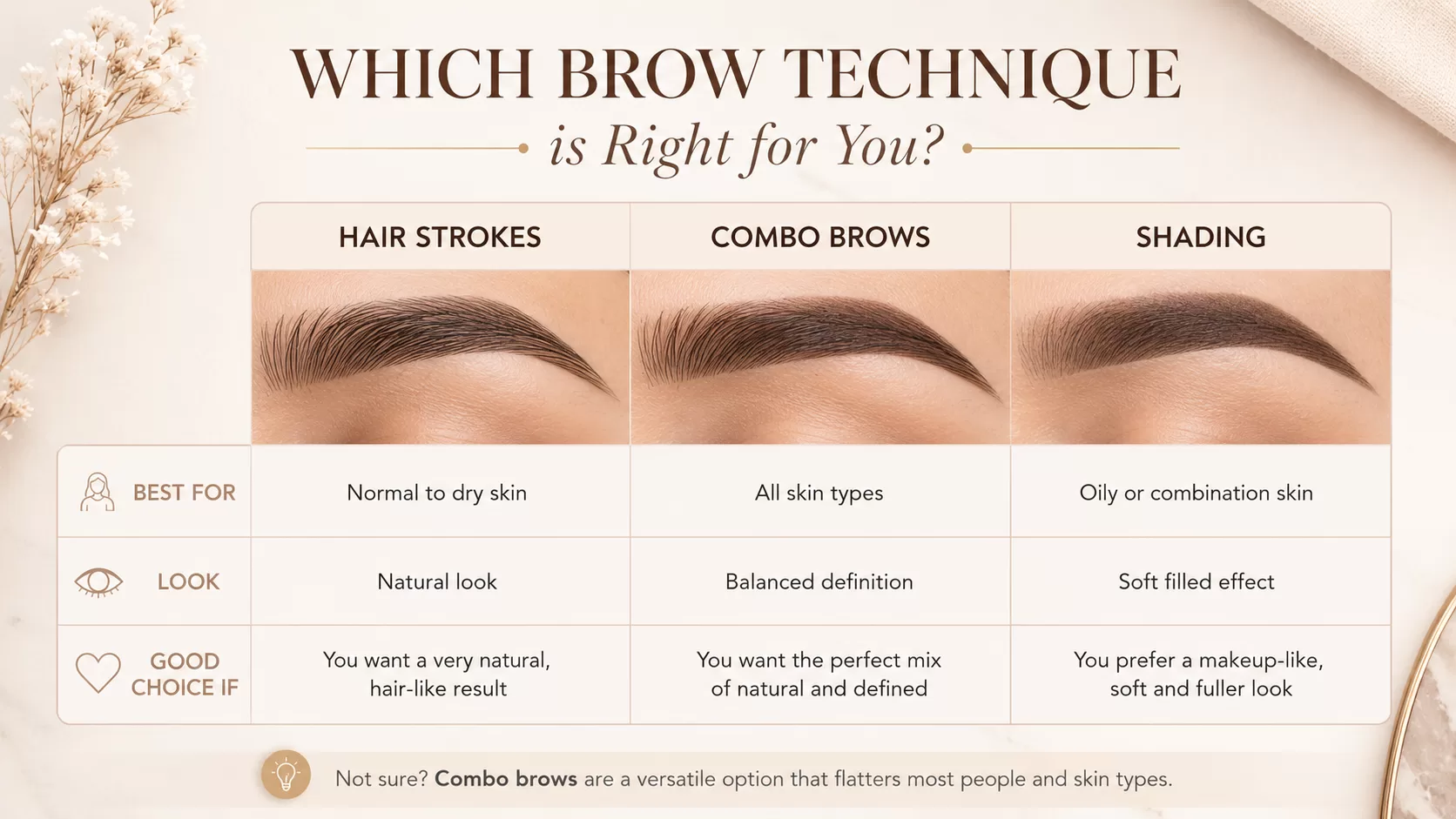
Choose nano hair strokes if:
You want the most realistic hair-like effect, already have some natural brow hair, and want people to notice your face rather than your permanent makeup.
Choose combo brows if:
You want realistic strokes plus extra definition through sparse areas, the body, or the tail.
Choose nano shading or ombre nano brows if:
You prefer a softly filled makeup effect, have skin that may not hold individual strokes as clearly, or want more visual structure than strokes alone provide.
But that is only the starting point.
Your skin can completely change the answer.
First, what are nano hair stroke brows?
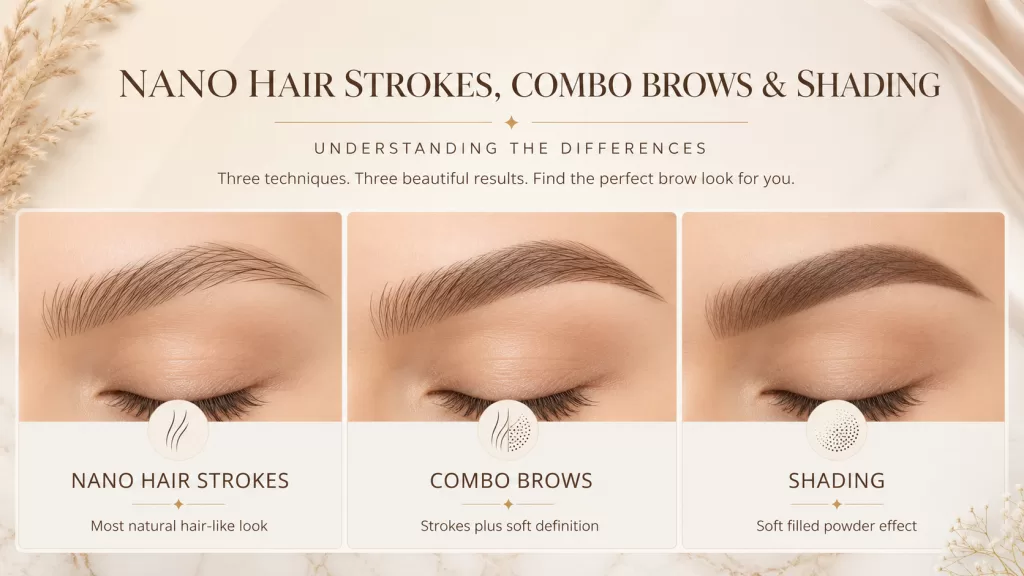
Nano hair stroke brows use very fine pigment placement to create lines designed to resemble individual eyebrow hairs.
The visual goal is not a perfectly filled block of color.
It is the opposite.
You should still see dimension, negative space, changes in direction, and the natural irregularity that makes real eyebrow hair look believable.
The Nano Blading describes its Nano Hair Stroke Brow service as using ultra-thin needles to place pigment and create a realistic hair-stroke effect.
This style is especially attractive to clients who say things like:
“I don’t want tattooed-looking eyebrows.”
“I rarely wear much makeup.”
“My tails disappeared, but I don’t want thick brows.”
“I just want people to think I naturally have good eyebrows.”
If that sounds like you, hair strokes deserve serious consideration.
Nano hair strokes may work particularly well when:
- You already have some natural brow hair
- You have small gaps rather than complete absence of hair
- Your natural hair pattern can help camouflage the added strokes
- You prefer a subtle everyday look
- You want definition without a powder-filled appearance
- Your skin can hold fine detail clearly
The emotional appeal is obvious.
You are not trying to create “new eyebrows.”
You are trying to restore what looks like it should have been there all along.
What are combo brows?
Combo brows combine hair-like strokes with soft shading.
Imagine nano hair strokes building the framework, then a whisper of color underneath providing the support.
That added shading can be useful when hair strokes alone would leave the brow looking unfinished.
For example, maybe you still have natural hair at the front of your brows, but your tails are extremely sparse. Pure strokes could help, but they may not create enough visual density through the entire shape.
Combo brows can bridge that gap.
They may use:
- Hair strokes toward the front
- Strokes through selected sparse areas
- Soft shading through the body
- More definition toward the tail
- A blended transition instead of an obvious line between strokes and shading
The result can still look natural.
Natural does not have to mean barely visible.
The goal is controlled definition.
Combo brows may be worth considering if:
- You want natural fronts but stronger tails
- Your brows have larger sparse areas
- You normally fill your brows with pencil or powder
- Pure hair strokes may look too delicate for your preferred style
- You want structure without a full powder-brow effect
- Your skin may cause some individual strokes to heal softer
This is why combo brows are often the middle ground for clients who are stuck between “too natural” and “too makeup-like.”
What are nano shading brows?
Nano shading brows create a softly filled effect rather than relying primarily on individual hair strokes.
Instead of trying to imitate every missing hair, pigment is distributed to create density and shape.
The Nano Blading currently offers Nano Ombré Shading Brows, describing the service as creating a soft shade gradient with greater definition through the brow.
When done conservatively, shading should not look like someone drew your eyebrows with a marker.
It can be extremely soft.
Think:
- Light at the front
- Gradually more defined through the body
- More structure toward the tail
- No hard square beginning
- No obvious block of pigment
That gradual transition is why you will often hear the phrase ombre nano brows.
Nano shading may make more sense if:
- You naturally prefer a filled-in brow
- Your brows are very sparse
- You have larger areas without natural hair
- Your skin does not reliably preserve delicate stroke separation
- You want your brows to look polished even without makeup
- You prefer a soft powder effect over individual hair detail
There is an important mindset shift here.
Some clients assume:
Hair strokes = natural
Shading = fake
That is far too simplistic.
A badly designed hair-stroke brow can look unnatural.
A beautifully designed shaded brow can look incredibly soft.
Technique matters, but design matters more.
The biggest deciding factor: Your skin
This is where I would stop choosing brows based on Instagram photos.
Your skin is the canvas.
And two people can receive a similar technique yet heal differently.
Permanent makeup is a form of cosmetic tattooing, and dermatologists note that factors involving the skin and procedure can affect outcomes and complications.
Research on eyebrow micropigmentation also suggests that high sebaceous activity can make semi-permanent pigment retention more difficult in some people.
That does not mean oily skin automatically disqualifies you from hair strokes.
It means the conversation needs to be more intelligent than:
“My friend got this, so I want the same thing.”
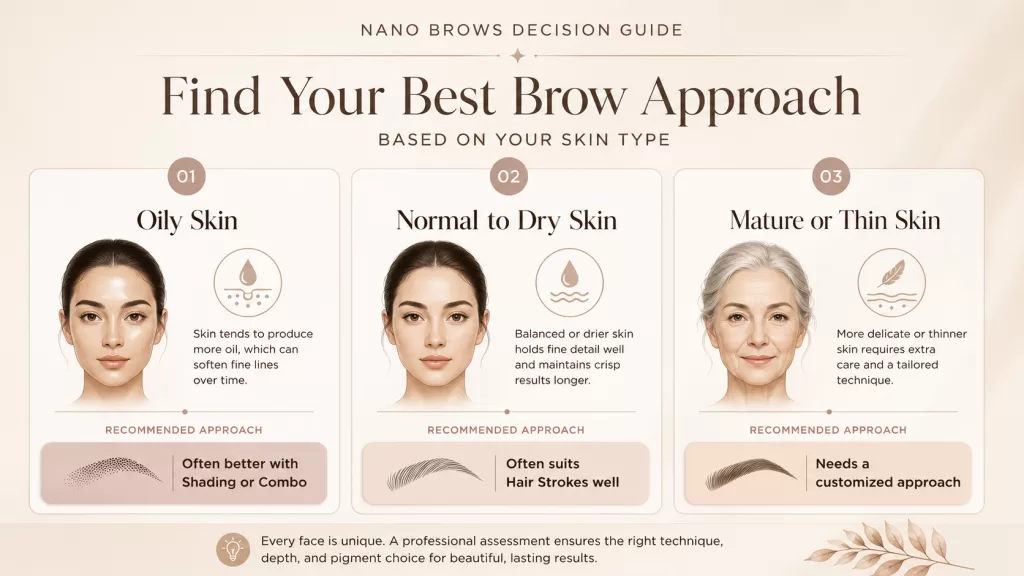
If you have oily skin
If your forehead and brow area become shiny quickly, your makeup tends to slide during the day, or you have more noticeable pores around the brows, tell your artist.
Hair strokes can still be possible, but you should understand that very fine lines may heal softer on some oilier skin types.
A 2025 clinical review of microblading noted poorer pigment retention in people with high sebaceous gland density or activity. The research is specifically about microblading rather than every machine nano-brow method, so it should not be turned into a universal rule. Still, it supports the practical reason artists evaluate oil production when choosing a technique.
For some clients, the smarter options may be:
Nano shading, if consistent color and definition matter most.
Or:
Combo brows, if you still want visible hair strokes but need shading to maintain structure.
Ask yourself:
Do I want perfect individual strokes at all costs?
Or do I want brows that still look balanced if those strokes soften?
That second question usually leads to a better long-term decision.
If you have normal or drier skin
Clients with balanced or drier skin may be good candidates for fine hair-stroke work when the rest of their skin characteristics are suitable.
That does not mean every person with dry skin should automatically choose nano hair strokes.
You still need to consider:
- Existing brow density
- Texture
- Previous permanent makeup
- Scarring
- Your preferred level of definition
- How much makeup you normally wear
But if your biggest priority is a very realistic hair-like result, this is where nano hair stroke brows often become especially attractive.
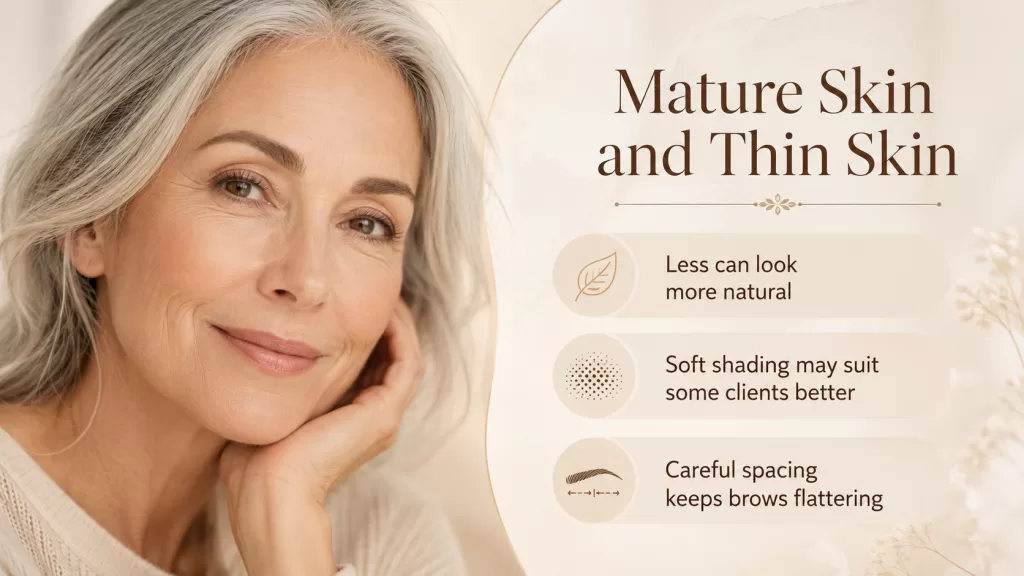
If you have mature skin
This deserves more honesty than the beauty industry usually gives it.
Mature skin can absolutely look beautiful with permanent makeup.
But “mature skin” is not one skin type.
One client may have smooth, healthy skin with fine natural brow hairs.
Another may have thinner, drier skin with more visible texture and fewer natural hairs.
The American Academy of Dermatology notes that skin commonly becomes thinner, drier, more easily irritated, and sometimes slower to heal as people age.
That means the goal should not be forcing the maximum number of hair strokes into the skin.
The goal is:
What will look soft, flattering, and believable once this heals?
Are nano brows good for mature skin?
They can be.
A mature client with suitable skin and enough existing brow hair may look beautiful with carefully spaced nano hair strokes.
But if the skin is very thin or textured, or there is very little natural hair to blend with, a softer shading technique or combo brow may provide a smoother overall appearance.
This is not a downgrade.
Sometimes fewer strokes plus controlled shading look more natural than trying to imitate dozens of tiny hairs across an area where the skin cannot visually support that much detail.
Do hair strokes blur on thin skin?
They can heal softer in some clients.
That is why spacing matters.
If strokes are packed tightly together, any softening can make them visually merge.
A more conservative design leaves negative space between strokes and uses your existing brow hairs as part of the final composition.
When I think about a mature brow, I would much rather see:
fewer believable strokes
than
too many strokes competing for attention.
More pigment is not automatically more beautiful.
Is shading better for aging skin?
Sometimes.
Not always.
If your skin is textured, delicate, or extremely sparse in natural hair, soft shading may create more visual consistency.
But if you have healthy skin and enough natural brow hair to blend with added strokes, nano hair strokes can still be a beautiful option.
The right answer comes from seeing your skin.
That is why a consultation matters.
Nobody should responsibly diagnose your ideal permanent makeup technique from three selfies and a comment section.
Your natural brow density matters almost as much as skin type
Imagine two clients.
Client A has a strong brow front but almost no tail.
Client B has very little natural hair anywhere.
Both ask for nano hair strokes.
Should they automatically receive the same technique?
Probably not.
For Client A
Hair strokes may integrate beautifully because natural hair already creates density through much of the brow.
The artist can concentrate on rebuilding missing areas.
For Client B
There is very little natural hair available to disguise pigment.
Pure hair strokes can still be considered, but a combo or softly shaded approach may sometimes create better overall balance.
This is why the best brow technique for your skin type also depends on what is actually growing on your face.
You are not choosing a filter.
You are building a design around existing anatomy.
How much makeup do you normally wear?
This question saves people from choosing the wrong technique.
Think about your real mornings.
Not vacation mornings.
Not “I should probably become a minimalist” mornings.
Your actual routine.
Choose nano hair strokes if you normally:
- Wear little brow makeup
- Prefer tinted moisturizer or minimal makeup
- Like seeing skin between your brow hairs
- Want subtle enhancement
- Do not want an obviously filled appearance
Consider combo brows if you normally:
- Fill sparse sections
- Define your arch and tail
- Like natural fronts with stronger structure
- Wear moderate makeup
- Want your brows to look complete without becoming dramatic
Consider nano shading if you normally:
- Fill your entire brow
- Prefer polished makeup
- Like a consistent shape every day
- Want more density than hair strokes can visually provide
- Feel uncomfortable when your brows look too soft
This matters because the wrong choice can create disappointment even when the technical work is excellent.
A person who loves bold makeup may think perfectly healed nano hair strokes are “too light.”
A person who rarely wears makeup may think beautifully executed shading is “too much.”
Neither technique failed.
The expectation match failed.
How do you avoid harsh brows?
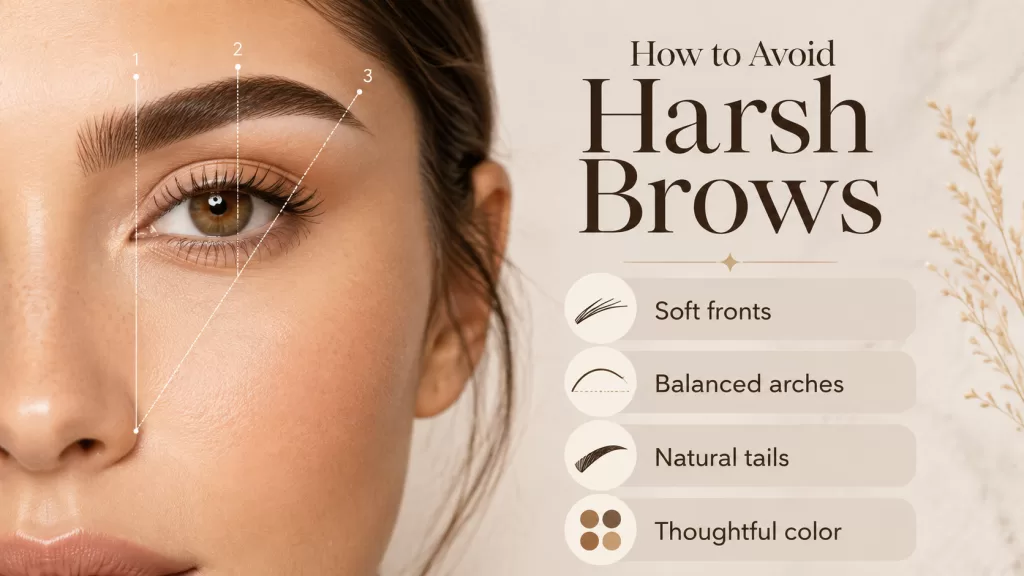
This may be the most important question in the entire article.
Harsh brows usually come from a combination of design choices rather than one specific technique.
Soft, flattering brows depend on:
A gentle beginning
The front of the brow should generally avoid looking like a solid vertical wall.
Thoughtful color selection
The darkest possible pigment is not automatically the best pigment.
A believable arch
A very high or sharply angled arch can dramatically change the expression.
Proper tail placement
A tail that extends too low can visually pull the eye area downward.
Appropriate density
More strokes or more shading are not automatically improvements.
Facial movement
Your face is not perfectly symmetrical.
Good brow mapping works with natural differences instead of trying to force both sides into mathematical clones.
The best brow should feel connected to you.
You should look in the mirror and think:
“My face looks better.”
Not:
“Wow. Eyebrows.”
What about previous microblading or old permanent makeup?
This can completely change the plan.
If you still have visible pigment from:
- Microblading
- Powder brows
- Ombre brows
- Previous nano brows
- Older cosmetic tattooing
tell your artist before booking.
New hair strokes need visual space.
If old pigment creates a strong gray, red, brown, or saturated background, adding more fine lines on top may not produce the clean hair-stroke effect you are imagining.
Sometimes correction may be appropriate.
Sometimes shading may work better.
Sometimes removal or additional fading should happen first.
The smartest decision may actually be:
Do less right now.
That is difficult to sell, but it is often easier than trying to repair years of pigment stacked on top of pigment later.
Houston changes the conversation slightly

If you are researching nano brows Houston, your lifestyle matters.
Houston means heat.
Humidity.
Sweat.
Outdoor events.
Pools.
Gym sessions where the walk from the parking lot somehow becomes part of the workout.
These factors matter especially during healing.
Your existing nanoblading aftercare guidance stresses protecting healing brows from excessive sweating, soaking, aggressive skincare, and other forms of irritation while the treatment area recovers.
This does not mean Houston clients should automatically avoid hair strokes.
It means you should tell your artist what your real life looks like.
If you:
- Train intensely several days per week
- Work outside
- Sweat heavily
- Spend significant time in the sun
- Swim frequently
- Have naturally oily skin
then longevity and healed softness should be part of your consultation.
You are not buying brows for the studio chair.
You are buying brows for your actual life.
Which brow technique lasts longest?
This is where beauty marketing tends to get dangerous.
There is no responsible universal answer.
All permanent makeup changes over time.
The visibility of your results depends on skin, pigment, placement, technique, sun exposure, skincare, healing, and how strong you personally like your brows to remain.
Traditional microblading literature commonly describes semi-permanent results rather than permanent, unchanging pigment.
For practical decision-making:
Hair strokes:
Prioritize realism and individual hair-like detail.
Shading:
Prioritizes visual density and a filled appearance.
Combo brows:
Try to preserve the realism of strokes while adding enough shading to maintain structure.
If longevity is your biggest concern, do not simply ask:
“What lasts longest?”
Ask:
“Which technique is most likely to age gracefully on my skin?”
That is a much better question.
How long do combo results last?
There is no fixed lifespan that applies to every client.
Combo results gradually soften based on factors such as:
- Skin behavior
- Oil production
- Pigment retention
- Sun exposure
- Skincare
- Aftercare
- Lifestyle
- How much shading was used
The useful advantage of combo brows is visual rather than magical.
If some hair strokes soften over time, the shading can continue providing structure.
That may help the brow look more complete during the fading process.
But no responsible artist should promise that combo brows will look exactly the same for a predetermined number of months.
The decision matrix: Which brow style sounds most like you?
| Your priority | Technique to discuss first |
|---|---|
| “I want nobody to know I had my brows done” | Nano hair strokes |
| “My front is fine, but my tails disappear” | Hair strokes or combo |
| “I fill my brows every morning” | Combo or shading |
| “I have very oily skin” | Shading or combo may deserve stronger consideration |
| “My skin is mature or textured” | Individual assessment, often conservative strokes, shading, or combo |
| “I want a polished powder look” | Nano shading |
| “I have almost no natural brow hair” | Combo or shading may provide more visual support |
| “I want natural fronts but stronger definition” | Combo brows |
| “I’m terrified of dark brows” | Conservative hair strokes or very soft customized shading |
| “I already have old pigment” | Assessment before choosing any new technique |
Use this as a conversation starter, not a diagnosis.
Five questions I would ask before saying yes to any brow technique
Before choosing a permanent makeup service, ask your artist:
1. Can I see healed results on someone with skin similar to mine?
Fresh photos are easy.
Healed results tell the truth.
2. What happens if my strokes heal softer than expected?
You want to know the backup strategy before you need it.
3. Would you tell me if shading would look better than hair strokes?
A good consultation should not be a sales pitch for one favorite technique.
4. How will you keep my brow fronts soft?
This immediately tells you whether the artist thinks about natural transitions.
5. What would make you refuse to perform hair strokes on me?
This may be the best question.
You want an artist who has reasons to say no.
Because someone willing to sell everyone the same brows is not customizing anything.
So, which technique should you choose?
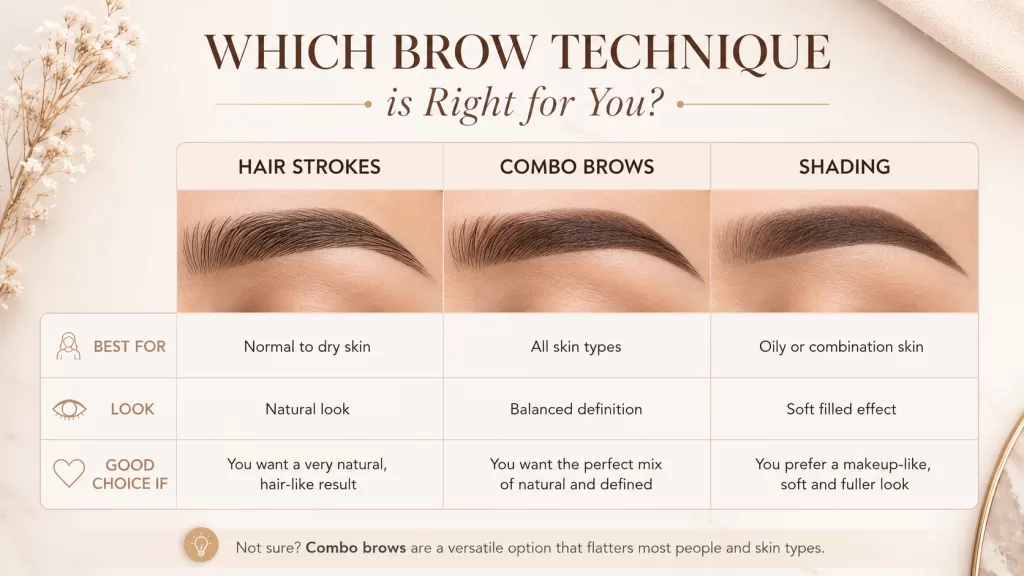
Here is the simplest way I can put it.
If your dream is:
“My brows, but naturally fuller”
start by exploring Nano Hair Stroke Brows in Houston. The goal of the service is realistic hair-like detail rather than a fully filled makeup effect.
If your dream is:
“I want my brows softly filled and consistently polished”
review Nano Ombré Shading Brows. The service is designed around a soft gradient and greater overall definition.
If you are somewhere between those two:
ask about a combination approach.
But do not walk into your consultation trying to force your skin into the technique you already selected online.
Walk in with the result you want.
Natural. Soft. Defined. Fuller. Polished. Barely there.
Those words matter more than the trend name.
Frequently Asked Questions
Are nano brows good for mature skin?
Yes, nano brows can be appropriate for mature skin, but the technique should be chosen according to the actual skin rather than age alone. Mature skin may become thinner, drier, more easily irritated, and slower to heal, although this varies greatly between individuals.
Some mature clients may be excellent candidates for carefully spaced hair strokes. Others may achieve a softer and more consistent appearance with shading or combo brows.
Do hair strokes blur on thin skin?
Fine strokes may heal softer on some thin or textured skin. This is one reason artists should avoid packing strokes too closely together and should evaluate how much natural brow hair is available to support the design.
A softer result does not automatically mean a bad result. Sometimes carefully spaced strokes that heal gently look more believable than extremely crisp, densely packed lines.
Is shading better for aging skin?
It can be better for some mature clients, especially when the skin has noticeable texture or there is very little natural brow hair.
It is not automatically better for everyone.
Healthy mature skin with sufficient natural hair may still work beautifully with nano hair strokes. The correct choice depends on the skin, brow density, desired finish, and professional assessment.
How do you avoid harsh brows?
Harsh brows are best avoided through conservative brow mapping, soft pigment selection, gentle brow fronts, appropriate arches, controlled density, and a technique matched to the client’s natural features.
The goal should be visual balance rather than creating the darkest or most symmetrical brow possible.
How long do combo results last?
There is no fixed lifespan that applies to every client. Combo brow longevity varies according to skin, oil production, pigment retention, sun exposure, skincare, lifestyle, healing, and maintenance.
The shading component can help maintain visual structure as individual strokes gradually soften.
You are not really choosing a technique. You are choosing how you want to feel when you look in the mirror.
That is the part most comparison guides miss.
Nobody wakes up thinking:
“I hope people admire the technical execution of my micropigmentation today.”
You want to wake up, look at your face, and feel like something that used to bother you no longer demands attention.
Maybe you are tired of drawing a missing tail.
Maybe one brow has always been thinner.
Maybe years of tweezing changed the shape.
Maybe you simply want to stop thinking about your eyebrows before coffee.
That is the real value of choosing the correct technique.
Not more pigment.
Not the trendiest brow.
Not whatever collected the most likes this month.
The goal is a brow that belongs on your face and fits the way you actually live.
If you are considering nano brows in Houston, start with a consultation rather than choosing the procedure yourself. Bring photos of how you normally wear your brows, explain what you are afraid of, and let your skin and natural hair help guide the final decision.
Book a consultation with The Nano Blading to compare nano hair strokes, combo brows, and soft shading based on your skin, natural brows, lifestyle, and preferred level of definition.
