
There is one fear I hear behind almost every permanent brow color question.
“What if they come out too dark?”
Sometimes it sounds slightly different.
Nano Brow Color Guide Houston: How to Choose a Shade That Heals Soft, Natural, and Flattering
There is one fear I hear behind almost every permanent brow color question.
“What if they come out too dark?”
Sometimes it sounds slightly different.
“What if my blonde hair ends up with brown brows that overpower my face?”
“What if the pigment turns gray?”
“What if my hair is almost black? Should my brows be black too?”
“What if my hair is dyed and I change it next year?”
Those are much better questions than simply asking which pigment color is most popular.
Because choosing the right nano brow color is not the same thing as choosing an eyebrow pencil.
A pencil sits on top of your skin and comes off tonight.
Permanent makeup pigment is placed into the skin. The FDA notes that permanent makeup can fade over time and may be difficult to remove if you later dislike the result.
That changes the decision completely.
The goal is not:
Which color looks impressive immediately after the appointment?
The goal is:
Which color is most likely to heal into a brow that still looks believable with your skin, natural brow hair, face, and personal style?
If you are researching nano brows in Houston, this guide will help you understand how artists think about skin undertones, hair color, natural brow density, previous permanent makeup, healing, shading versus hair strokes, and long-term fading before choosing a pigment.
The quick answer
The best nanoblading color usually comes from evaluating several things together:
Your natural brow hair matters. Your skin tone and undertone matter. Your current hair color matters, but it should not automatically dictate the pigment. Previous permanent makeup can completely change the plan. And your preferred look matters because a very soft nano hair stroke brow can visually read lighter than a densely shaded brow even when similar pigment families are used.
Most importantly, the pigment should be chosen for the healed result, not only for what looks attractive when freshly applied.
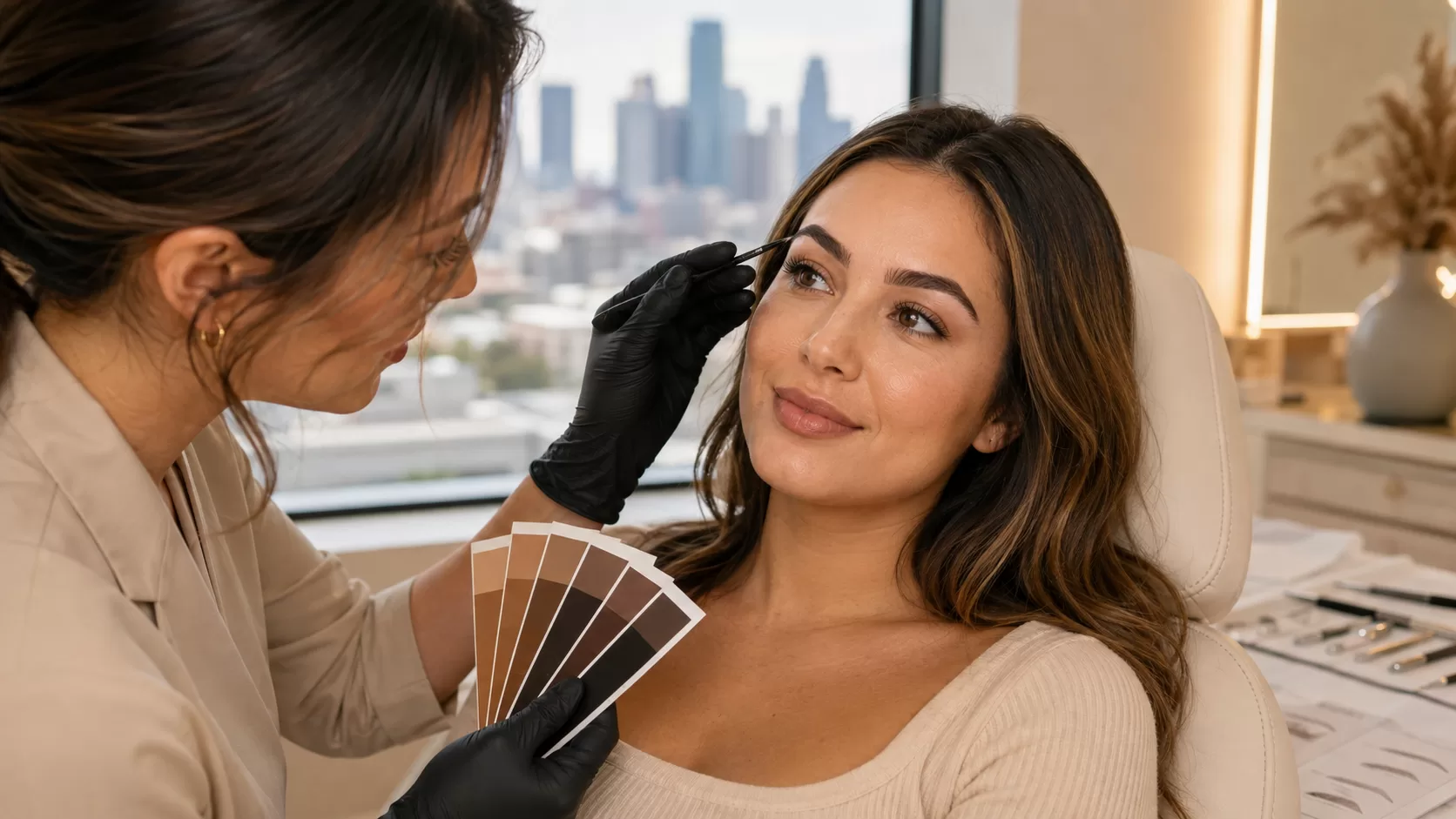
That is why I would never recommend choosing permanent brow pigment from an online color chart alone.
Your artist needs to see you.
Fresh pigment and healed pigment are not the same thing
This is where a lot of unnecessary panic begins.
You leave the appointment, look in the mirror and think:
That is darker than I expected.
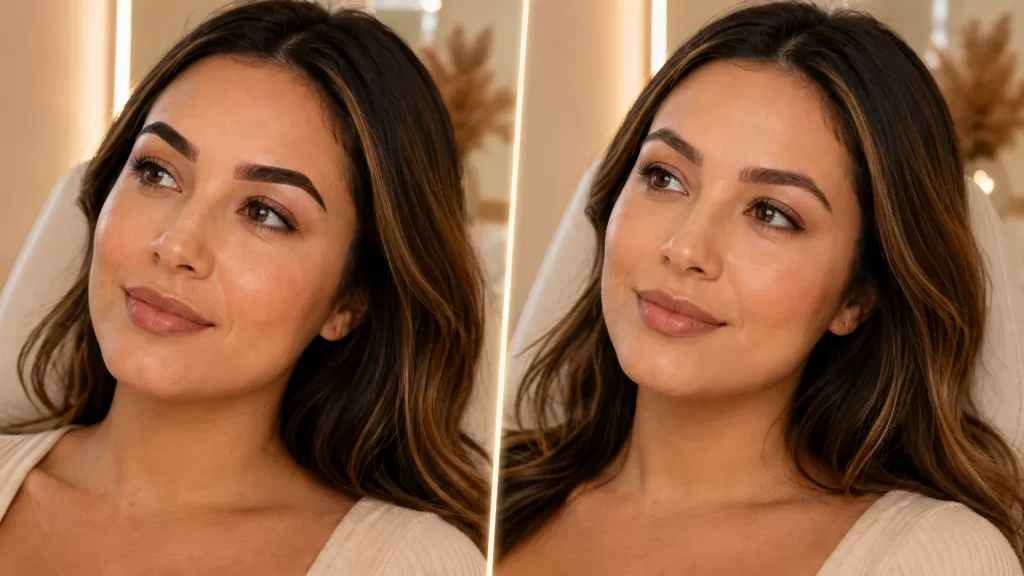
Fresh permanent makeup often appears stronger, sharper, and more noticeable before the skin settles. Your brows then move through healing stages where they may look darker, flaky, lighter, patchy, and eventually softer.
That means day one is not the correct moment to decide whether your nano brow pigment color was successful.
Your updated healing guide already explains that the brow color and individual strokes can continue settling for several weeks before the result becomes easier to evaluate.
So when selecting color, your artist should be thinking ahead.
Not:
“This pigment looks perfect right now.”
But:
“How do I expect this pigment to read after this client’s skin heals over it?”
That distinction separates color selection from color guessing.
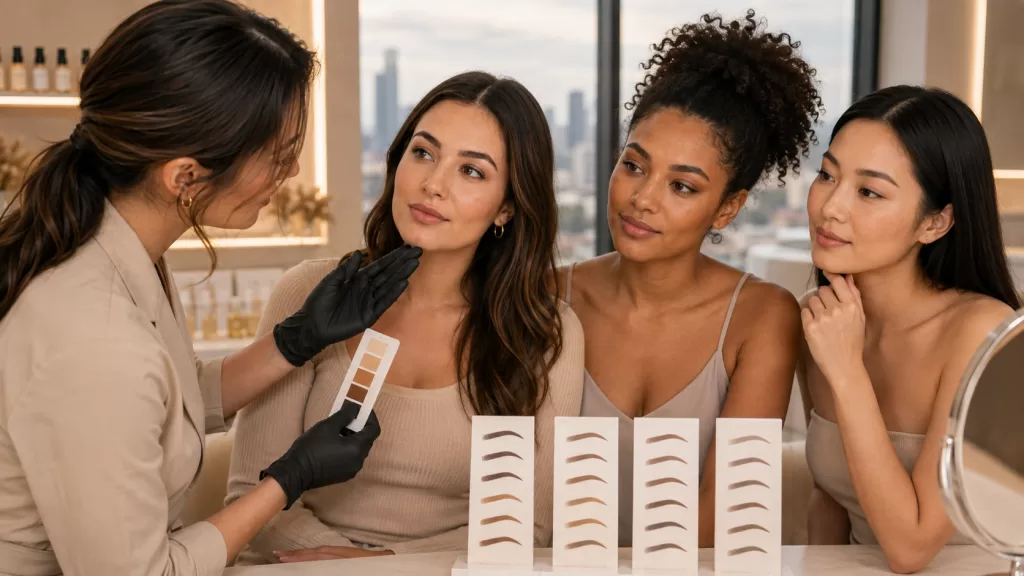
Skin tone and skin undertone are not the same thing
You can have light skin with a warm undertone.
Medium skin with a cool undertone.
Deep skin with a neutral undertone.
Skin tone refers broadly to how light or deep your complexion appears.
Undertone refers to the underlying warmth, coolness, or neutrality that influences how colors visually interact with your skin.
For permanent makeup, the artist is not simply putting “brown” onto a blank canvas.
The pigment will be seen through your healed skin.
That is why professional permanent makeup pigment selection considers the client, the pigment, the technique, and the expected healed appearance together.
Warm undertones
Warm complexions may visually carry golden, peach, or yellow characteristics.
That does not automatically mean your artist should choose the warmest pigment available.
Too much warmth can become obvious.
The artist’s job is to create balance.
Cool undertones
Cooler complexions can have more pink, red, or bluish visual characteristics.
Again, this does not mean “pick ash brown.”
Overcorrecting toward a very cool color can produce a brow that feels dull or heavy.
Neutral undertones
Neutral skin often contains a more balanced combination of warmth and coolness.
But even here, there is no universal “neutral brown” that works for everyone.
Natural brow hair, hair color, previous pigment, technique, and desired intensity still matter.
Your natural brow hair is often more important than your hair dye
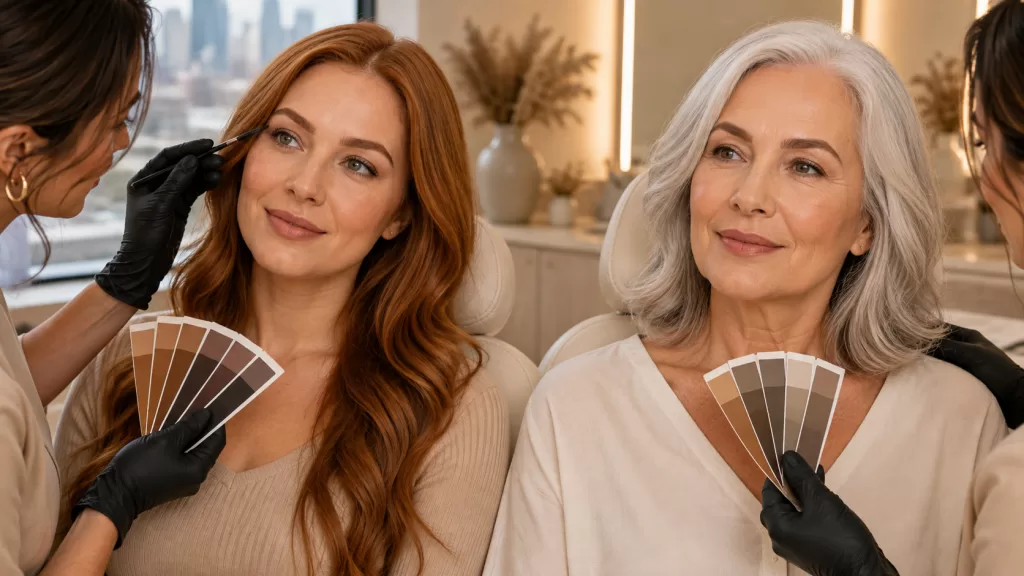
Someone may currently have platinum blonde hair while their natural eyebrow hairs are medium brown.
Another client may color her hair black while her natural brow hairs remain much softer.
Which should the permanent makeup match?
Usually, the conversation begins with what is already happening around your eyes, not simply the color sitting on top of your head.
Your existing eyebrow hairs give the artist information about:
- Natural depth
- Visual density
- How new strokes will blend
- Whether the tattoo should disappear into existing hair or create more contrast
That is why a good nano brow color consultation should involve seeing your actual brows before a final pigment decision is made.
Nano brow colors for blonde hair
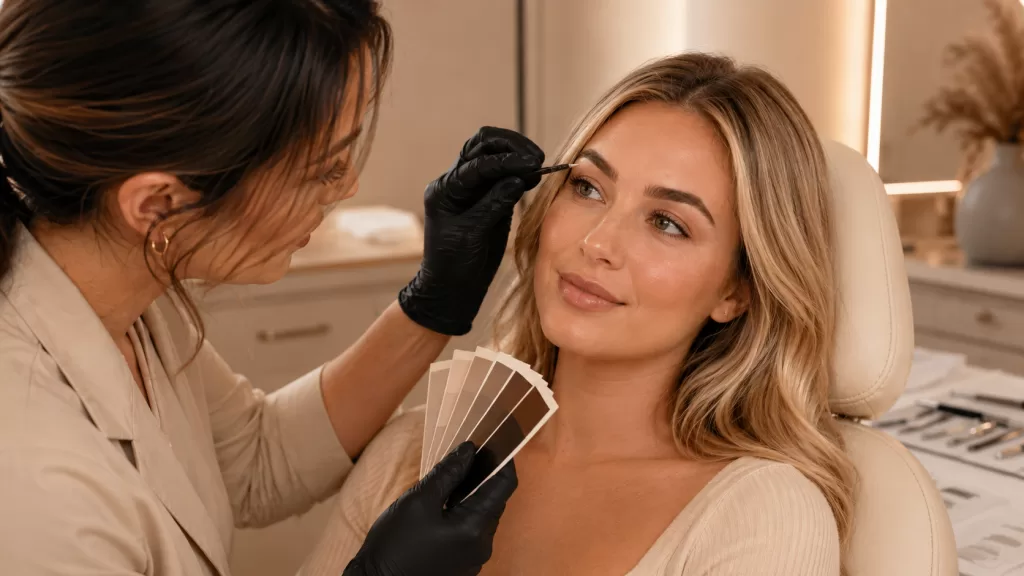
Blonde clients often worry about permanent makeup looking too dark.
That concern makes sense.
A very dark eyebrow can dominate a face where the hair, lashes, and overall contrast are naturally soft.
For many blonde clients, pigment selection may lean toward softer brown, taupe, or neutral-brown families depending on the natural brow hair and skin undertone.
But “blonde” covers an enormous range.
There is:
platinum blonde, ash blonde, golden blonde, honey blonde, dark blonde, highlighted hair and naturally light hair with surprisingly dark brows.
So this rule is far more useful:
Do not choose your nano brow color because a website says blondes need taupe. Choose it according to the amount of contrast that already looks natural on your face.
If you normally fill your brows softly, tell your artist.
If you naturally have dark brow hairs despite blonde hair, tell them you want the pigment to integrate rather than artificially lighten the whole brow.
Nano brow colors for brunette hair
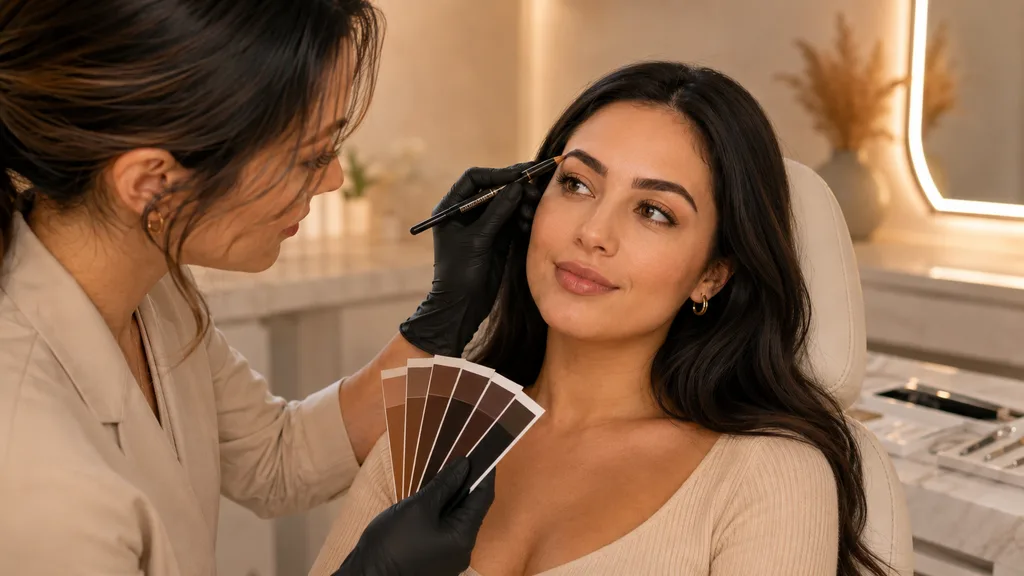
Brunettes have an equally wide range.
Soft medium brown hair and almost-black espresso hair should not automatically receive the same pigment.
A good artist considers whether your natural eyebrows appear:
- Light brown
- Medium brown
- Deep brown
- Neutral
- Warm
- Cool
- Sparse or dense
Then the permanent makeup can support what is already there.
For clients wanting natural nano hair stroke brows, matching visual depth is particularly important because the added strokes need to coexist with real hair.
If the tattooed strokes are dramatically darker than every natural hair around them, your eye may notice the tattoo before it notices the brow.
That defeats the purpose.
What if your hair is black?
For permanent makeup, “my hair is black, therefore my tattoo should be black” is not a safe design rule.
Very dark hair can certainly support deeper brow definition, but pigment should still be selected according to the person’s skin, existing brow hairs, desired healed effect, and long-term appearance.
A softer deep brown can often read extremely dark once it is surrounded by natural black brow hairs.
Remember:
You are not coloring every eyebrow hair.
You are adding pigment underneath or between them.
That visual interaction matters.
What if you have red or auburn hair?
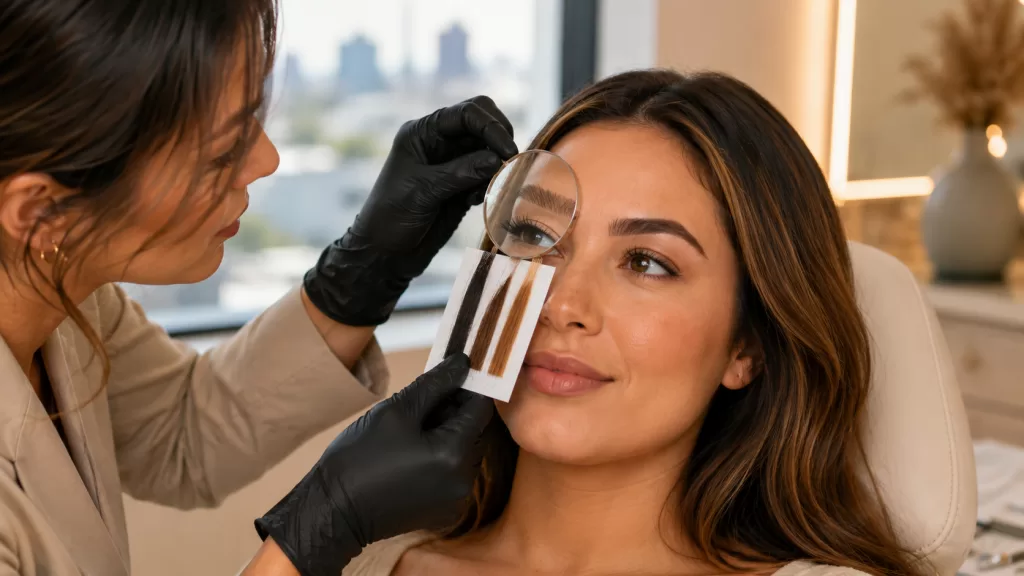
Red hair creates another mistake-prone area.
The instinct is to choose obviously red pigment.
That can become too literal.
For someone with auburn, copper, strawberry blonde, or naturally red hair, the artist may need warmth in the color strategy, but the brow should still look like an eyebrow.
Natural redheads often have brow hairs that appear brown, taupe, golden brown, or muted auburn rather than bright copper.
The goal is harmony.
Not matching your eyebrows to a hair-color swatch from the salon.
What about gray, silver, or white hair?
Clients with gray or silver hair sometimes assume the eyebrow pigment should also be gray.
Not necessarily.
Your natural brow hairs may still contain brown, dark blonde, charcoal, or mixed tones.
A very cool permanent makeup color can sometimes make the brow feel heavier or more artificial than intended.
For mature clients especially, softness may be more flattering than chasing an exact hair-color match.
The goal should be to restore enough brow definition to frame the eyes while respecting the lower contrast that often looks beautiful with silver or white hair.
Think:
structure without shouting.
What if you dye your hair regularly?
This is one of the strongest reasons not to match permanent makeup too aggressively to your current hair color.
Imagine choosing a very warm brow because your hair is copper today.
Then next year you go dark brunette.
Or blonde.
Your brow pigment does not get the memo.
The FDA specifically notes that permanent makeup that originally looked flattering may later clash as skin tones, facial contours, preferences, and appearance change.
If you change hair color frequently, tell your artist.
A more adaptable brow color often makes more sense than designing permanent makeup around one temporary hairstyle.
Hair strokes and shading can make the same color feel completely different
This is one of the most useful concepts for readers deciding between techniques.
Imagine drawing five fine brown lines on white paper.
Now take the exact same brown and fill an entire rectangle.
Which looks darker?
The rectangle.
The pigment did not change.
The density did.
The same idea applies to brows.
Nano hair strokes
Nano hair strokes leave visible skin between the individual strokes.
That negative space can make the overall brow feel lighter, airier, and more realistic.
Your site’s Nano Hair Stroke service is specifically designed around fine hair-like pigment placement and a natural-looking result.
Nano shading
Shading puts more visual color through the brow.
Even with a soft pigment choice, the finished brow may appear more defined because there is greater overall density.
Your Nano Ombré Shading service is designed to create a soft gradient and more filled appearance rather than relying entirely on individual hair strokes.
This is why asking only:
“Which pigment color should I choose?”
misses half the decision.
You also need to ask:
“How much of this color will be placed into the brow?”
Natural versus bold does not simply mean light versus dark
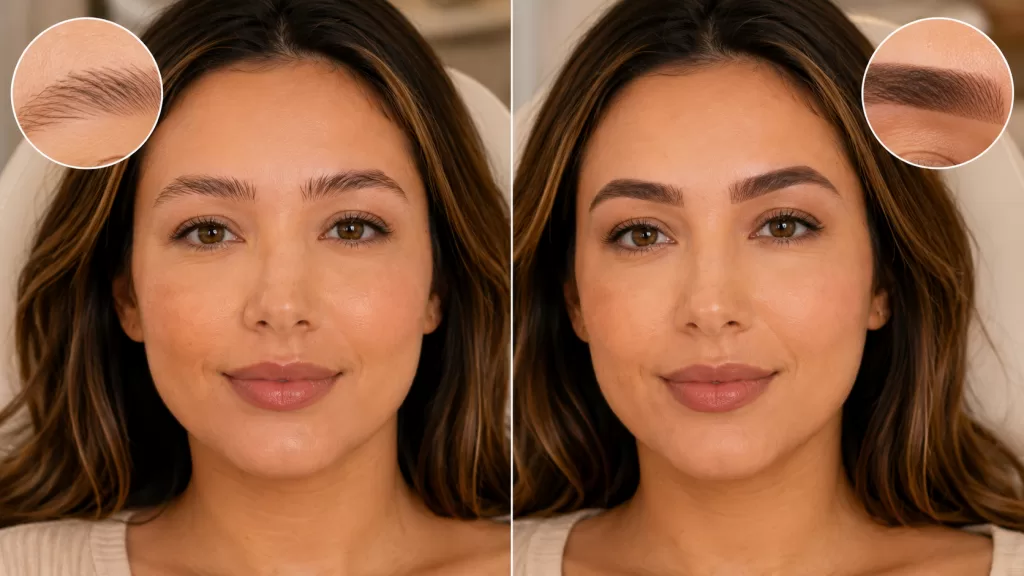
Permanent makeup design is more sophisticated than that.
A stronger brow can come from:
- Greater density
- More shading
- A sharper outline
- A fuller tail
- Increased thickness
- Stronger contrast
A softer brow can come from:
- More visible skin
- Gentle fronts
- Well-spaced hair strokes
- Gradual shading
- Lower overall density
You can therefore have a fairly deep pigment applied very delicately.
Or a lighter pigment applied so densely that the brow still looks heavy.
Color and design have to work together.
Why your eyes also matter
Eye color is not normally the first factor I would use to choose brow pigment.
But it affects the overall amount of contrast on your face.
Dark eyes with dark lashes may visually support stronger brow definition.
Very light eyes, light lashes, light hair, and low facial contrast may look more harmonious with a softer eyebrow.
Again, this is not a rigid formula.
It is part of looking at the entire face instead of treating the eyebrow as an isolated strip of skin.
Previous permanent makeup can completely change your color options
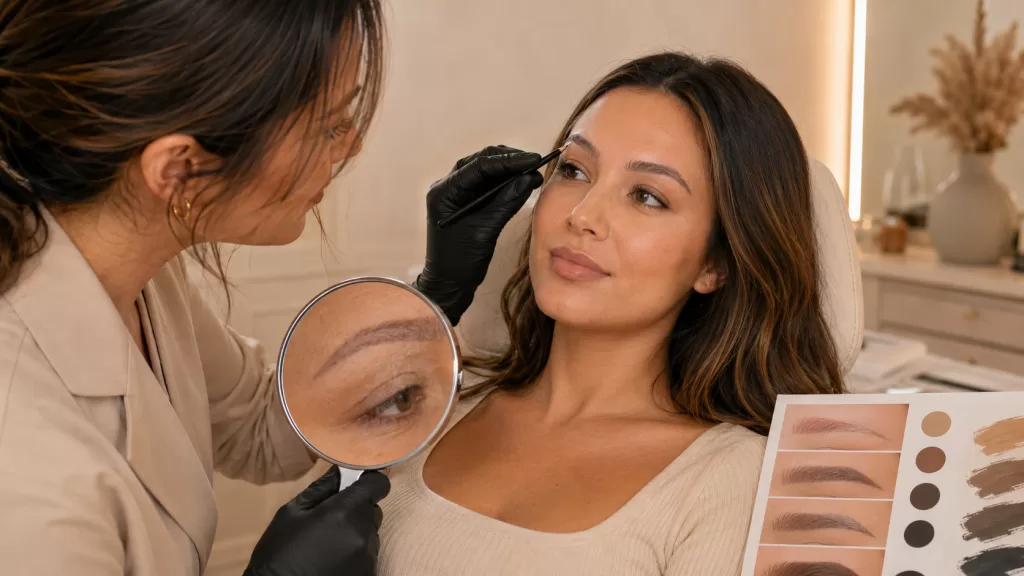
If you already have old microblading, powder brows, ombré brows, or another cosmetic eyebrow tattoo, the pigment selection process becomes more complicated.
Your artist needs to evaluate:
- What color remains
- How saturated it is
- Whether it looks warm or cool
- Whether the existing shape is usable
- Whether new strokes will even remain visible
- Whether correction or removal should come first
If the existing brow looks gray, red, orange, blue-gray, or heavily saturated, simply placing your preferred new brown on top may not produce the result you expect.
A qualified nanoblading artist should evaluate old pigment before making promises.
Sometimes the best color decision is not a color.
It is:
“We should not add more pigment yet.”
That answer can save you from a much harder correction later.
Can nano brow pigment turn gray, red, or orange?
Pigment can change visually as permanent makeup ages and fades.
The FDA confirms that tattoo and permanent makeup pigment can fade, and pigment placed too deeply can migrate and create blurred results.
In practice, unwanted warm, cool, gray, red, orange, or ashy appearances can be associated with several interacting factors, including the original pigment choice, existing pigment underneath, depth, saturation, skin characteristics, fading, and repeated work.
That does not mean every color change was caused by one specific mistake.
It means long-term pigment behavior is another reason to choose the artist as carefully as you choose the shade.
Your brow color should be designed for how it ages, not just how impressive it looks in the artist’s fresh portfolio.
Does skin type affect nano brow color?
Skin type affects more than color alone.
Oily, dry, mature, textured, and combination skin may differ in how well they retain fine detail and how the healed permanent makeup appears.
That can influence technique selection and eventually how the overall color reads.
For example, if individual hair strokes heal very softly, a client may perceive the brow as lighter even though the pigment itself was correctly selected.
This is why your consultation should combine:
color + technique + skin + desired healed result.
Never treat them as four separate decisions.
Why Houston sun exposure matters
Houston gives us plenty of sunshine.
That is wonderful for many things.
Permanent makeup longevity is not necessarily one of them.
The FDA notes that tattoos and permanent makeup can fade over time.
Once your brows are fully healed, thoughtful sun protection and sensible skincare around the brows become part of protecting both your skin and the appearance of the pigment.
During active healing, however, follow your artist’s instructions rather than immediately applying products to healing skin.
Your updated nanoblading aftercare guide should remain the deeper resource for washing, sweating, sun exposure, skincare, and healing instructions.
Why brows sometimes look “wrong” during healing
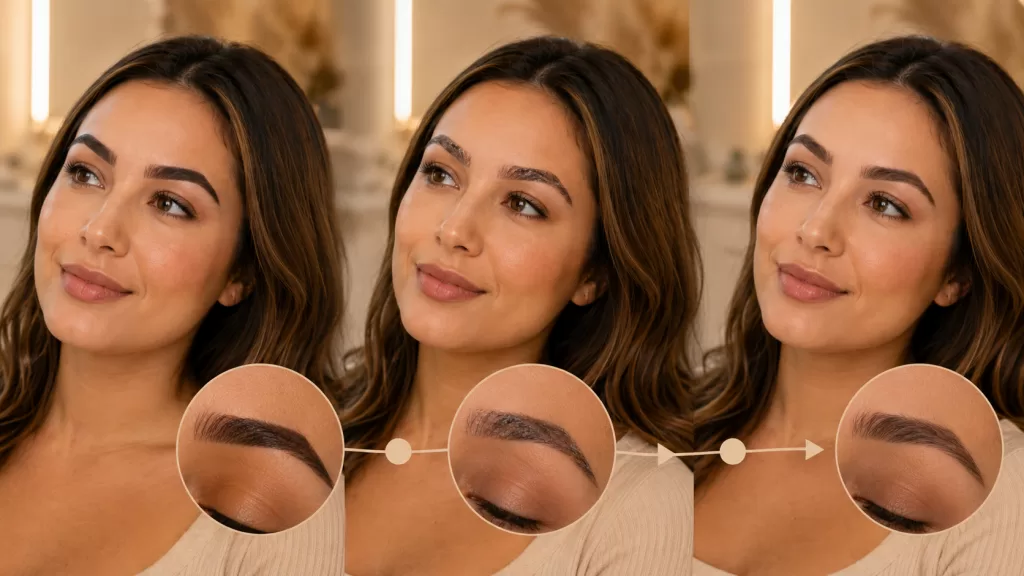
There are several moments when clients decide their color must be wrong.
Day two:
“They’re too dark.”
Around the flaky stage:
“They’re patchy.”
Later:
“They disappeared.”
Then:
“Oh. They’re coming back.”
This is why permanent makeup requires patience.
Fresh pigment is not the final color.
Actively flaking pigment is not the final color.
The lighter ghosting stage is not necessarily the final color.
Evaluate the brows after the recommended healing period.
Your existing What to Expect After Nanoblading article and Nano Brows Touch-Up guide should internally support this section.
What if the color genuinely heals too light?
A healed result that is slightly softer than desired can sometimes be easier to refine than a result that begins heavily saturated.
That is why conservative pigment planning has an advantage.
At a perfecting session, your artist can evaluate the actual healed skin and determine whether:
- Certain strokes need reinforcement
- More density is appropriate
- The color needs adjustment
- Shading should be added
- Nothing should be changed
The touch-up should respond to what your skin actually did.
Not blindly repeat the first session.
What if the color heals too dark?
First:
Do not panic during the first few days.
Second:
Do not attack your brows with scrubs, acids, retinol, makeup remover, or internet “fading hacks.”
Wait for healing and contact your artist.
If permanent makeup remains genuinely too dark or the wrong color after healing, correction can be more complicated than simply tattooing a lighter pigment over it.
The FDA warns that removing permanent makeup can require multiple treatments and complete removal without scarring may not always be possible.
That is exactly why the smarter strategy is conservative selection before treatment rather than aggressive correction afterward.
Five questions I would ask during a nano brow color consultation
Before pigment is placed into your skin, ask your artist:
- What are you matching the pigment to: my brow hair, scalp hair, skin, or all of them?
- How do you expect this color to look after it heals?
- Would this pigment still work if I change my hair color?
- Does my previous permanent makeup affect the color choice?
- Will hair strokes or shading make this pigment appear stronger?
If your artist can explain those answers clearly, you are having a real pigment consultation.
If the entire explanation is:
“This is our most popular brown.”
I would keep asking questions.
Frequently asked questions about nano brow color
How do I choose the right nano brow color?
The best nano brow color should be selected according to your natural brow hair, skin tone, undertone, hair color, previous permanent makeup, preferred level of definition, chosen technique, and expected healed result. A professional consultation is more reliable than selecting pigment from an online color chart.
Should nano brows match my hair exactly?
Not necessarily. Your natural eyebrow hairs and facial contrast often matter more than matching the current color of your scalp hair exactly. This is especially important for people who dye their hair frequently.
What nano brow color is best for blonde hair?
Blonde clients often suit softer brown, taupe, or neutral-brown families, but the correct color depends on natural brow hair, skin undertone, and desired contrast. Blonde hair alone is not enough information to select a permanent makeup pigment.
Should black-haired clients get black brows?
Not automatically. Very dark hair may support deeper brow definition, but permanent makeup should still be selected according to skin, natural brow hair, technique, and desired healed softness. The darkest available pigment is not automatically the most flattering choice.
Why do nano brows look darker right after the appointment?
Fresh pigment is more visible in newly treated skin, so the brows often look stronger and more defined initially. The appearance usually softens during healing.
Can nano brow pigment change color over time?
Permanent makeup can fade and change visually over time. Pigment selection, placement, skin characteristics, previous permanent makeup, fading, skincare, sun exposure, and saturation can all influence the way aged brows appear.
What if I already have gray or red permanent makeup?
Existing pigment should be evaluated before adding new permanent makeup. Depending on its color, saturation, shape, and depth, correction, additional fading, a different technique, or removal may need to be considered before new nano hair strokes are added.
Can I change my nano brow color later?
Adjustment may be possible, but it is not as simple as changing eyebrow pencil. Permanent makeup can be difficult to remove, so it is better to plan conservatively before the initial procedure.
The best nano brow color should disappear into your face, not announce itself
That is the standard I would use.
When someone looks at you, the first thought should not be:
“Nice tattooed eyebrows.”
It should be:
“She looks good.”
Maybe your eyes look more defined.
Maybe your face feels more balanced.
Maybe your brows finally look complete even when you are not wearing makeup.
The pigment did its job precisely because nobody is analyzing the pigment.
Choosing the right nano brow color in Houston means thinking beyond hair-color charts and trendy shades. It means considering your skin, natural eyebrow hair, technique, existing pigment, lifestyle, desired softness, and how the color is expected to heal.
If your biggest fear is ending up too dark, say that during your consultation.
If you change hair colors constantly, say that.
If you love stronger makeup, say that too.
Your artist cannot design the right healed color around preferences you never mention.
The Nano Blading currently offers both Nano Hair Stroke Brows for a more hair-like result and Nano Ombré Shading Brows for clients seeking a softer filled effect. The technique and pigment choice should be planned together rather than treated as separate decisions.
Book a consultation to choose a brow technique and pigment based on your real skin, natural brows, hair, and preferred healed result, not a generic color chart.In conclusion, selecting the right nano-blading color is a personalized journey that involves understanding your skin undertones, harmonizing with your hair color, considering your eyebrow shape, and aligning with your personal style. By paying attention to these factors and embracing experimentation, you’ll achieve a stunning look that enhances your natural beauty. Remember, the key is to choose a nano-blading color that suits your features and boosts your confidence, leaving you with eyebrows that are nothing short of fabulous.
