
Choosing a nanoblading artist is one of those decisions that looks simple until you remember where the work is going.
Right in the middle of your face.
You can return a dress that does not fit. You can repaint a wall when the color feels wrong. Brows are different. If the shape, color, placement, or technique is wrong, you may be looking at that decision every morning while figuring out correction, fading, or removal.
That is why searching for the best nano brow artist in Houston should involve more than scrolling through ten beautiful Instagram photos and choosing whoever has an opening Saturday.
A qualified artist should be able to show you more than pretty brows.
They should be able to show you:
- Healed work
- Proper training and continuing education
- A licensed professional studio
- Clear hygiene procedures
- Brow designs customized to different faces.
- A thorough consultation process
- Realistic expectations
- Written aftercare
- A sensible touch-up policy
- The ability to say, “No, this technique is not right for you”
That last one matters more than most clients realize.
A professional’s job is not simply to sell you nano brows. Their job is to determine whether nano hair strokes, shading, a combination technique, correction, or sometimes no new pigment at all is the smartest choice for your skin and existing brows.
If you are comparing nanoblading services in Houston, use this guide before you put down a deposit.
Quick answer: How do you know if a nanoblading artist is qualified?
A strong nano brow artist in Houston should work from a properly licensed studio, follow clear infection-control procedures, show both fresh and healed permanent makeup results, explain their training and experience, customize brow mapping to your face, evaluate your skin and previous pigment, provide written aftercare, and answer questions without pressuring you to book.
In Texas, permanent cosmetics and microblading fall under tattoo-studio regulation. The Texas Department of State Health Services requires businesses performing permanent cosmetics to maintain a current site-specific license, and that license should be displayed at the studio.
That gives you a very good first question:
“Can I see your studio license?”
A legitimate professional should not act offended because you asked.
First, understand what service you are actually buying
One problem with the permanent makeup industry is inconsistent terminology.
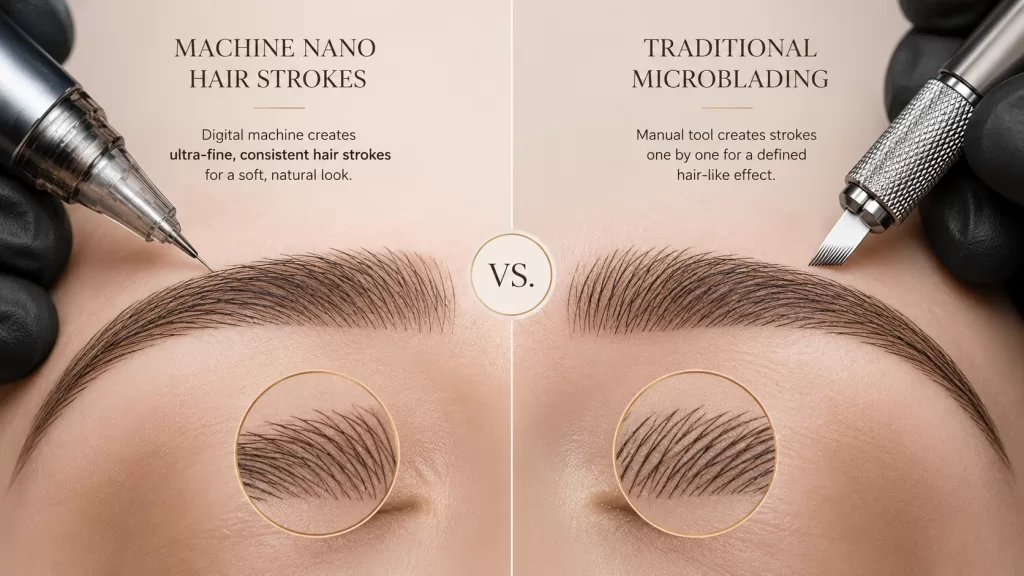
Traditional microblading generally uses a manual blade-based tool to create hair-like incisions. Modern nano hair stroke brows are commonly created with a digital or machine-based permanent makeup device and a fine needle configuration.
The visual goal may be similar, but the techniques are not necessarily the same.
At The Nano Blading, the Nano Hair Stroke Brow service uses a machine-based approach intended to create fine, realistic-looking hair strokes.
Why should you care?
Because when interviewing an artist, you need to ask:
“What technique are you actually using on me?”
Not simply:
“Do you do nanoblading?”
A professional should be able to explain:
- Whether they use a machine or manual method
- Why they recommend that technique for your skin
- Whether hair strokes are appropriate
- Whether shading would heal more predictably
- Whether combo brows may provide better structure
- How previous permanent makeup affects the plan
If the explanation is basically, “This is the newest technique and everyone loves it,” keep looking.
Your face deserves a better consultation than a trend pitch.
1. Check that the studio is properly licensed
This is step one because everything else becomes less interesting if the business itself is operating outside the applicable requirements.
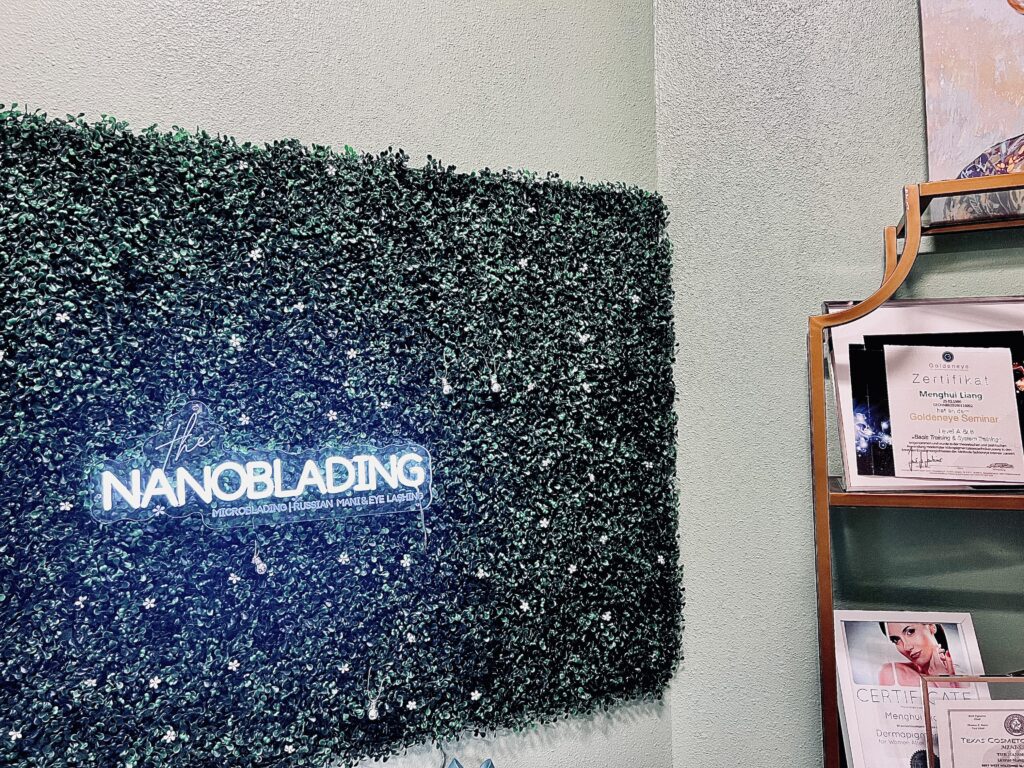
Texas DSHS states that businesses providing permanent cosmetics, microblading, or other tattooing services must hold a current tattoo studio license. The license is tied to the physical studio location.
Texas also says licensed studios are inspected for requirements involving cleanliness, universal precautions, single-use gloves, appropriate disposable or sterilized instruments, waste handling, and client records.
What you should do
When you arrive for your consultation, look for the studio’s license.
You can also ask:
- Is this location currently licensed for permanent cosmetics?
- Where is the treatment performed?
- Is the permanent makeup service performed at this licensed location?
Do not assume that a beautiful salon automatically means permanent makeup procedures are authorized there.
A marble countertop is not an infection-control credential.
2. Look at healed brows, not just fresh brows
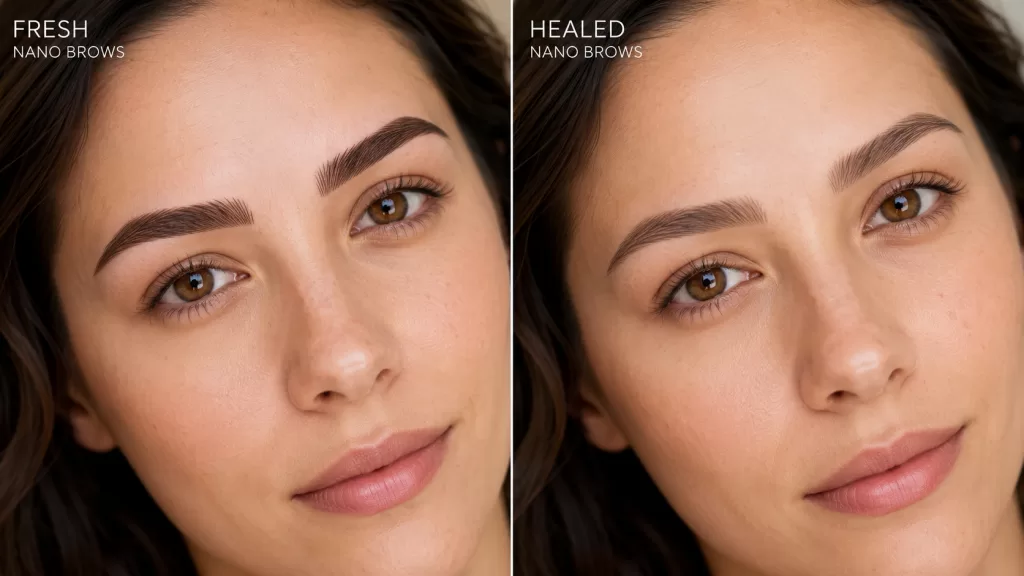
This may be the single most useful portfolio test.
Fresh permanent makeup can look spectacular.
The pigment is crisp. The lines are visible. The camera lighting is controlled. There has not been enough time for the client’s skin to reveal how it retained the work.
But you are not buying fresh brows for an Instagram photograph.
You are buying healed brows.
Ask the artist:
“Can you show me healed nano brows from clients who came back several weeks later?”
Then look carefully.
Good healed work should make you notice:
- Natural-looking color
- Softness rather than heavy saturation
- Hair strokes that still make visual sense
- A shape appropriate for that client’s face
- Smooth transitions through the brow
- Reasonable symmetry without looking stamped on
- No obvious harsh square at the front
This is especially important when choosing natural nano brows in Houston, because beautiful hair-stroke work should still look believable once the dramatic fresh stage has passed.
Your current healing guide already explains that nano brows can change significantly during the first several weeks before the result becomes easier to evaluate.
So when an artist’s entire portfolio consists of photos taken immediately after the appointment, you are missing half the evidence.
3. Make sure every client does not receive the same eyebrows
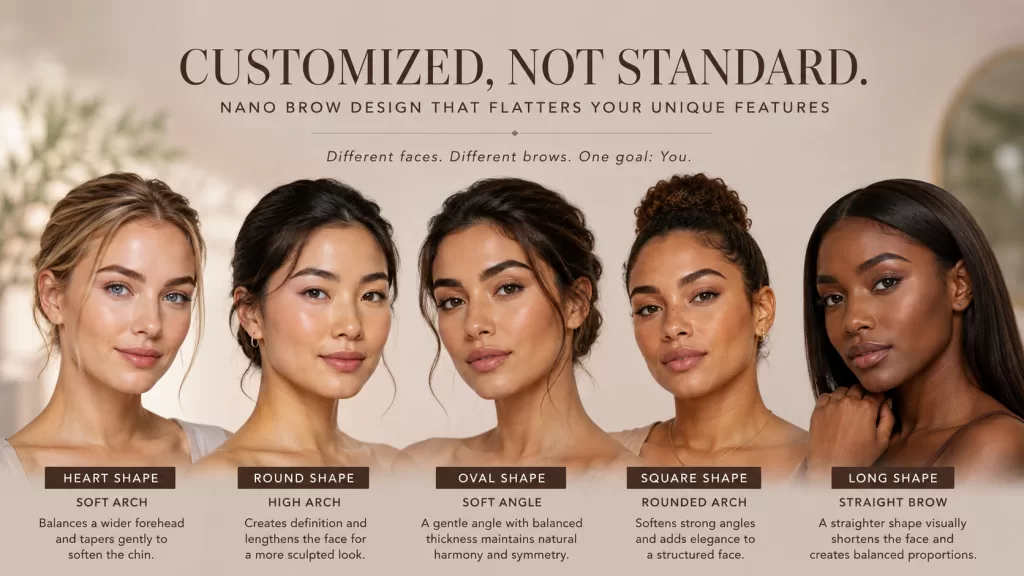
This is an easy red flag to spot once you know to look for it.
Open the artist’s portfolio and compare ten different clients.
Do all ten have:
- The same arch?
- The same thickness?
- The same tail?
- The same dark front?
- The same stroke pattern?
That is not customization.
That is a template.
A qualified permanent makeup artist in Houston should design brows around factors such as:
- Natural brow position
- Existing brow hair
- Facial proportions
- Bone structure
- Brow muscle movement
- Skin characteristics
- Previous permanent makeup
- The client’s daily makeup style
- The client’s desired level of definition
Good brow mapping is not about forcing every face into perfect symmetry.
Faces are naturally asymmetric. The aim is visual balance.
Your brow should look like it belongs to you, not like you accidentally subscribed to the artist’s signature eyebrow.
4. Ask to see clients with skin and brows similar to yours
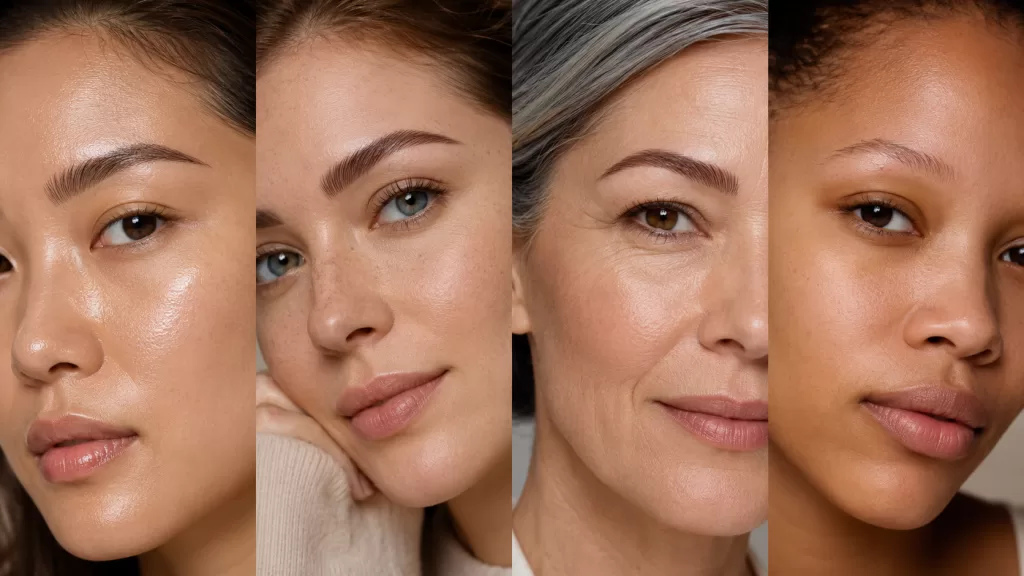
A portfolio can contain beautiful work and still tell you almost nothing about how the artist will approach your situation.
If you have oily skin, ask for oily-skin healed results.
If you have mature skin, ask for mature-skin clients.
If you have almost no natural brow hair, look for clients who started with similar sparse brows.
If you have old microblading, ask to see correction work.
This matters because the best brow technique for your skin type may not be the same technique used in the photograph that brought you to the studio.
You may love an ultra-fine nano hair stroke result but discover during consultation that:
- Your existing pigment is too saturated
- Your skin may heal fine strokes very softly
- You need greater visual density
- Combo brows could work better
- Soft shading may create a more predictable result
A professional should care more about the healed result than selling you the technique name you typed into Google.
5. Training matters, but certificates are only the beginning
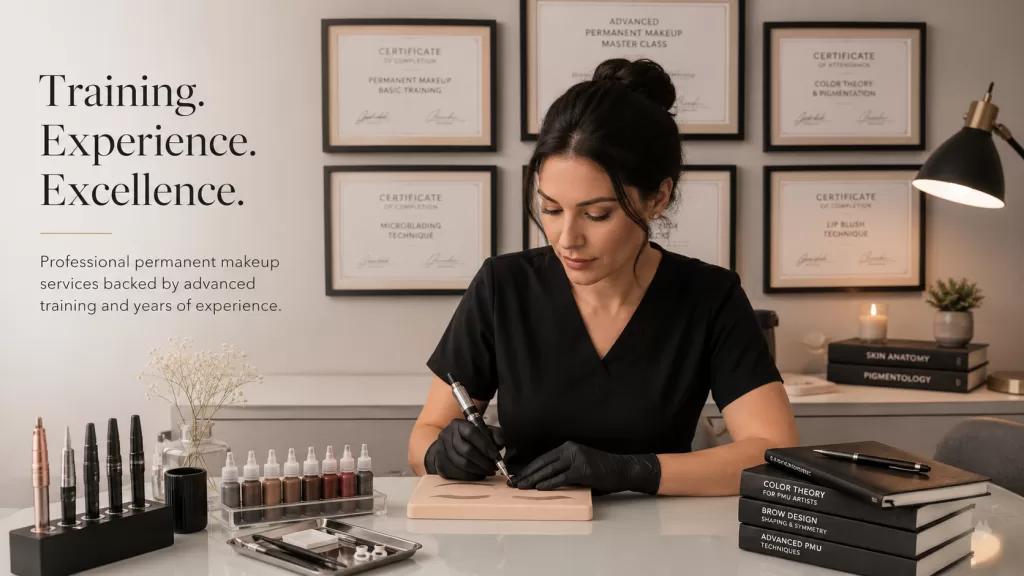
Training is important.
It tells you the artist invested time learning the equipment, pigment theory, skin considerations, sanitation, brow design, and procedure.
But a wall full of certificates is not enough by itself.
Someone can take a course.
That does not automatically tell you:
- How many clients they have treated
- Whether they continue learning
- Whether they understand different skin types
- Whether their work heals well
- Whether they can correct mistakes
- Whether they have developed artistic judgment
Ask better questions:
“How long have you been doing permanent makeup?”
“What additional training have you completed since your first course?”
“Which technique do you specialize in?”
“How has your technique changed over the years?”
“What kinds of brows do you refuse to work over?”
Those questions reveal depth.
The Nano Blading’s artist profile, for example, describes Phoebe Liang’s background in cosmetology, digital micropigmentation training beginning in 2015, additional permanent makeup education in 2017, and ongoing work in micropigmentation.
That type of history gives potential clients something concrete to evaluate beyond “certified artist.”
6. Watch what happens before the needle ever touches you
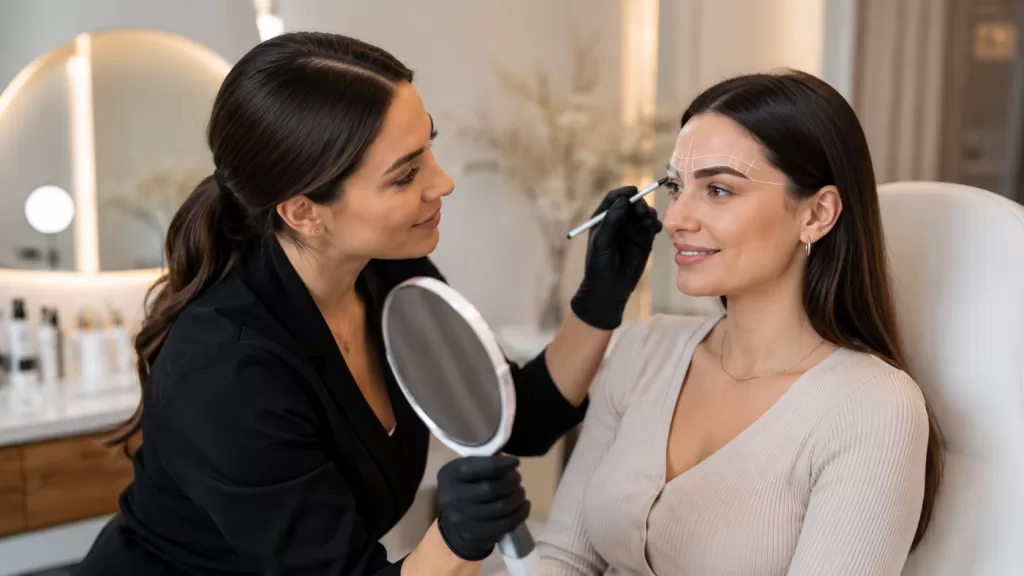
The consultation tells you a lot about the appointment you are about to have.
A rushed consultation should make you uncomfortable.
A thoughtful consultation should involve questions.
The artist should want to know things such as:
- What bothers you about your current brows?
- How do you normally fill them?
- How natural or defined do you want them?
- Have you had previous microblading or permanent makeup?
- What skincare treatments do you use?
- Are you planning cosmetic treatments around the appointment?
- Do you have health conditions, allergies, or medications relevant to the service?
- Are there reasons the procedure should be postponed?
A professional consultation is partly artistic and partly risk management.
If the consultation consists of:
“What shape do you want?”
followed by:
“Great, lie down.”
that is not enough.
7. A good artist is willing to tell you no
This sounds like terrible sales advice.
It is excellent trust advice.
Imagine you walk in asking for ultra-thin nano hair strokes, but you already have dense old pigment underneath.
A desperate artist sees money.
A qualified artist sees a problem.
The correct answer may be:
- Wait for more fading
- Consider removal
- Use a different technique
- Correct the existing color first
- Do not add more pigment yet
You should want an artist who protects the long-term appearance of your brows even when the answer delays the sale.
This is one of the strongest signals that you are talking to a professional instead of someone trying to fill tomorrow’s appointment calendar.
8. Study the hygiene process before you study the decor
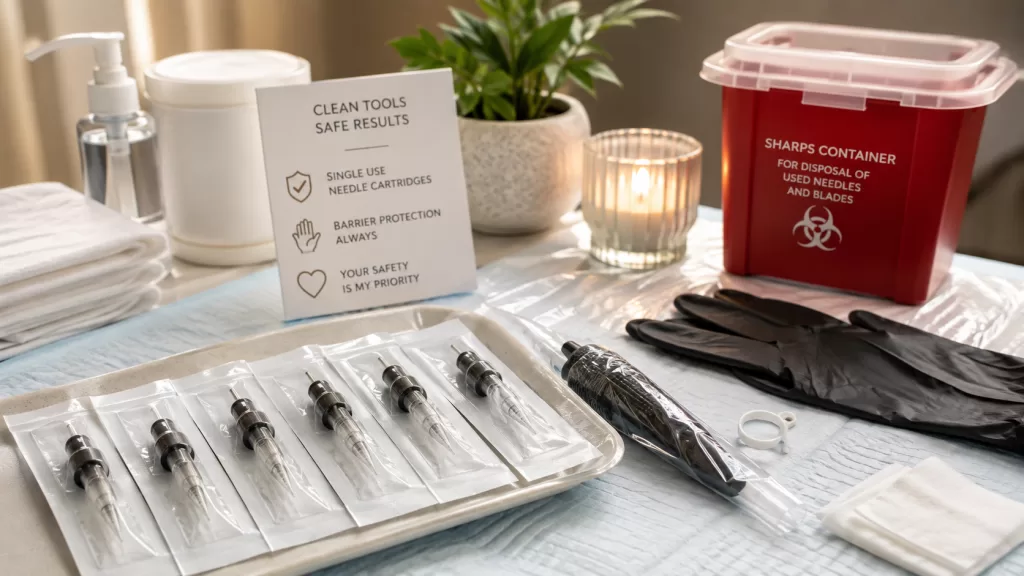
The treatment room does not need to look like a luxury hotel.
It does need to look controlled and clean.
Texas DSHS specifically identifies infection-control practices such as handwashing, single-use gloves, protective equipment, disposable or properly sterilized instruments, and appropriate waste handling as part of studio requirements.
CDC investigations of tattoo-related infections have also emphasized aseptic technique, hygienic practices, and avoiding nonsterile products or water during tattoo procedures.
During your consultation, pay attention.
Green flags
- Fresh gloves
- Clean treatment surfaces
- Single-use components opened for the client
- Appropriate sharps disposal
- Clearly organized clean and used materials
- No casually reused disposable supplies
- The artist can explain sanitation without becoming vague
Red flags
- Used tools sitting around the workstation
- Gloves touching phones, drawers, doors, and then your skin
- Unclear answers about disposable needles
- A visibly dirty treatment surface
- Open products that appear contaminated
- The artist brushes off hygiene questions
Do not feel awkward asking.
You are allowing someone to place pigment into your skin.
You have officially earned the right to be picky.
9. Ask what pigment and equipment they use
You do not need to become a permanent makeup chemist before your appointment.
You should still be able to ask what is being used.
Try:
“Which pigment system do you use?”
“Is the needle or cartridge single-use?”
“Can you show me the unopened cartridge before the procedure?”
“How do you prevent cross-contamination?”
A qualified artist should not need a five-minute search on their phone to remember which pigment they are putting into your face.
The point is not memorizing brand names.
The point is transparency.
10. Do not judge an artist by Instagram followers
Large audience does not equal great healed work.
Small audience does not equal poor work.
Social media is useful for discovering artists, but it can distort your evaluation because:
- Photos may be heavily edited
- Lighting can hide skin texture
- Fresh pigment photographs especially well
- The best ten clients may be shown repeatedly
- Follower counts can have little relationship to technical skill
Use social media as the beginning of your research.
Then move to:
- Healed portfolios
- Google reviews
- Studio information
- Artist background
- Consultation quality
- Licensing
- Hygiene
- Policies
The art is permanent enough that choosing by follower count is a weak due-diligence strategy.
11. Read reviews for patterns, not just stars
A 5.0 rating feels reassuring.
The language inside the reviews is more useful.
Look for repeated mentions of:
- Listening during consultation
- Brow mapping
- Natural results
- Clean studio
- Patience
- Clear aftercare
- Good healed results
- Thoughtful touch-up experience
- Professional communication
Also read negative reviews.
One unhappy client does not automatically mean the artist is bad. Every established business eventually meets someone who dislikes something.
What matters is the pattern.
Multiple complaints about:
- Poor sanitation
- Rushed mapping
- Unexpected fees
- Ignored messages after the procedure
- Severe asymmetry
- Aggressive sales pressure
deserve attention.
And watch how the business responds.
A calm, factual response reveals more professionalism than an online argument that somehow becomes twelve paragraphs long.
12. Understand the full price before booking
There is nothing wrong with looking at price.
There is something wrong with making it the only variable.
A $100 cheaper appointment stops being a bargain very quickly if you later need correction or removal.
Before paying a deposit, ask:
- What does the initial service include?
- Is consultation included?
- Is the perfecting touch-up included?
- If not, what does it cost?
- How long is the touch-up eligibility window?
- What happens if I need additional work?
- Are old permanent makeup corrections priced differently?
- What is the cancellation policy?
The goal is not necessarily choosing the most expensive artist.
Expensive does not automatically mean qualified.
The goal is avoiding mystery pricing.
A professional should be able to explain exactly what you are paying for.
The 60-second portfolio test
If you have five artists open in different browser tabs, use this.
Give each artist one point for every “yes.”
| Do they show healed work? | |
| Do different clients receive different brow shapes? | |
| Can I find results on skin similar to mine? | |
| Are brow fronts soft and believable? | |
| Do the colors look natural after healing? | |
| Is previous PMU discussed honestly? | |
| Is artist training clearly explained? | |
| Is the studio legitimate and licensed? | |
| Are aftercare and touch-ups explained? | |
| Can I easily find real client reviews? |
An Instagram account full of gorgeous day-one brows but zero healed work would fail the test quickly.
That is useful information.
10 Questions to Ask a Nano Brow Artist Before Booking
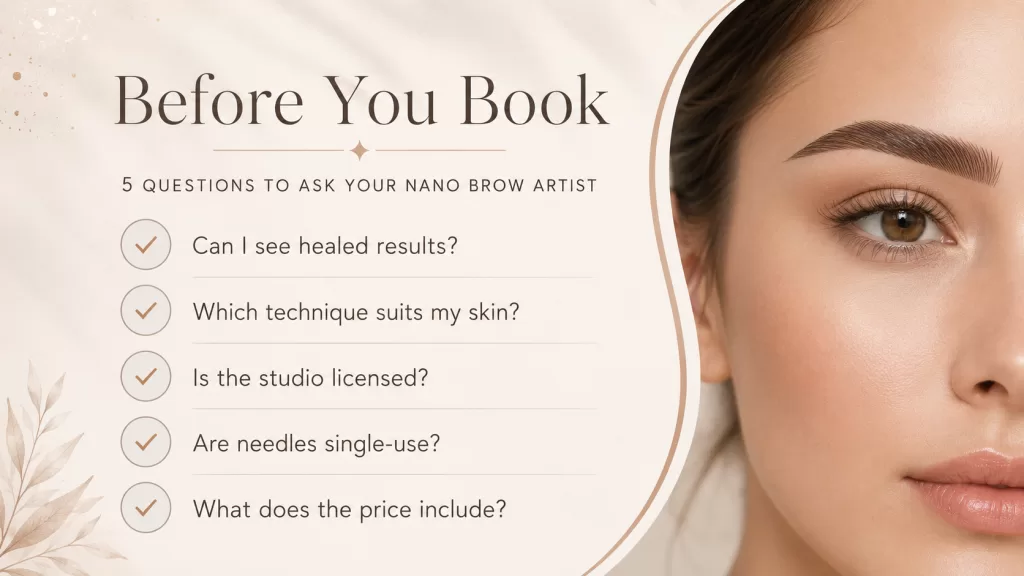
You can screenshot this section and bring it to your consultation.
- Can you show me healed nano brow results?
- Have you worked with clients who have skin similar to mine?
- Which brow technique would you recommend for me, and why?
- Do you use machine nano hair strokes, manual microblading, shading, or a combination?
- What permanent makeup training have you completed?
- Is this studio currently licensed for permanent cosmetics in Texas?
- Are the needle cartridges and relevant treatment components single-use?
- How do you customize brow mapping to my natural features?
- What happens if my pigment heals lighter or patchy?
- What does my price include, including touch-ups?
Then ask one bonus question:
“Is there any reason you would not recommend nano hair strokes for me?”
That answer can tell you more about the artist than the other ten combined.
Red flags that should make you reconsider booking
There are some situations where I would simply walk away.
The artist refuses to show healed work
Fresh photos are not enough.
Every client has the same brow
You are looking at a stencil strategy, not facial customization.
They immediately agree with everything you request
A good professional should sometimes challenge an unrealistic idea.
They dismiss your previous permanent makeup
Old pigment matters.
They will not explain hygiene
There is no good reason to hide infection-control procedures.
They guarantee an exact healing result
Skin is biological. Pigment retention varies.
They promise perfect symmetry
Humans are not perfectly symmetrical.
They pressure you to pay immediately
You are allowed to think before permanently changing your face.
The deal seems unbelievably cheap
Low cost alone is not proof of bad work, but a price dramatically below the local market deserves questions about training, location, licensing, materials, and experience.
The cheapest brows in Houston can become extraordinarily expensive if you later need to fix them.
How to find a qualified nanoblading artist near you
If you are searching “nanoblading artist near me” or “nano brow artist Houston,” do not stop at Google’s first result.
Build a shortlist.
Step 1: Search locally
Try combinations such as:
- nano brows Houston
- nano hair stroke brows Houston
- permanent makeup artist Houston
- natural nano brows Houston
- nano brow artist near me
Step 2: Open the service page, not just the homepage
A serious permanent makeup provider should explain what they actually do.
Step 3: Find the artist
You should be able to identify who will perform the procedure and learn about their background.
Step 4: Check the portfolio
Fresh and healed.
Step 5: Read reviews from multiple places
Do not rely only on testimonials copied onto the artist’s own site.
Step 6: Verify the studio
In Texas, permanent cosmetics are performed through studios subject to DSHS tattoo-studio licensing requirements.
Step 7: Book a consultation before committing
Your final choice should happen after someone has actually looked at your brows.
What should a good consultation feel like?
You should leave with more clarity than you arrived with.
Maybe you thought you wanted hair strokes and discovered combo brows may better suit your skin.
Maybe you worried that your brows would look too dark and learned how the artist plans a softer front and color.
Maybe you have old microblading and the smartest plan is waiting.
That is what a professional consultation should do.
It should reduce uncertainty.
Not increase urgency.
If you leave feeling that you must pay immediately before an imaginary “last slot” disappears, you have experienced sales pressure, not better brow planning.
What should you expect after choosing your artist?
The relationship should not end when the procedure ends.
Texas DSHS states that clients must be provided oral and written care instructions after tattooing services.
For nano brows, you should understand:
- How to care for the area
- Which products to use or avoid
- What normal healing may look like
- When to contact the studio
- When makeup or exercise can resume
- When the artist will evaluate healed retention
- Whether a perfecting touch-up is recommended
That is why artist selection and aftercare are connected.
The person you choose should be there for the entire process, not simply the two hours you spend in the chair.
Frequently asked questions about choosing a nanoblading artist
How do I know if a nanoblading artist is qualified?
Look at the whole picture: relevant permanent makeup training, real experience, healed portfolio work, a licensed studio, clear hygiene procedures, thoughtful consultation, customized brow mapping, written aftercare, and transparent touch-up policies.
No single certificate or social media metric proves quality on its own.
Does a permanent makeup studio in Texas need a license?
Yes. Texas DSHS requires businesses performing permanent cosmetics, microblading, and other tattooing services to hold a current tattoo studio license for the location where the service is provided. The license should be displayed prominently.
Should a nano brow artist show healed results?
Yes. Healed work is one of the most useful ways to evaluate an artist because permanent makeup changes during recovery. Fresh results alone cannot show how the pigment ultimately settles.
What should I look for in a nano brow portfolio?
Look for variety, healed results, soft color, realistic hair patterns, appropriate brow shapes for different faces, and examples involving skin or natural brows similar to yours.
Should I choose a nanoblading artist based on price?
Price should be part of your decision, but not the only factor. Compare training, healed work, studio licensing, hygiene, consultation quality, reviews, technique, and what is included in the fee.
Is nanoblading the same as microblading?
Not necessarily. Traditional microblading usually refers to a manual blade-based technique. Nano hair stroke brows are commonly created using a digital permanent makeup machine and fine needle configurations. Ask the artist exactly which technique they use.
What should I ask about sanitation?
Ask whether relevant needle cartridges are single-use, how treatment surfaces are disinfected, how cross-contamination is prevented, and how disposable or reusable instruments are handled. Texas-licensed studios are expected to follow infection-control requirements such as single-use gloves and appropriate disposable or sterilized instruments.
Should an artist refuse to work over old microblading?
Sometimes. Existing pigment may make new hair strokes inappropriate or affect the color and design. A qualified artist should evaluate old work before deciding whether new pigment, correction, shading, fading, or removal makes sense.
The artist you choose matters more than the trend you choose
It is easy to get obsessed with whether you want nanoblading, nano hair strokes, combo brows, or shading.
Those choices matter.
But the artist matters more.
A skilled professional can look at the brow technique you saved from Instagram and tell you why it will work beautifully.
A better professional can look at it and tell you why it will not.
That honesty is worth paying attention to.
You are choosing someone who will make dozens of tiny aesthetic decisions about the most expressive area of your face. Their job is not simply making your brows fuller.
Their job is protecting your face from a result that does not belong there.
If you are looking for a nano brow artist in Houston, review the artist’s healed work, ask about the technique, verify the studio, understand the aftercare process, and schedule a consultation before you make the final decision.
At The Nano Blading in Houston, clients can explore Nano Hair Stroke Brows, Nano Ombré Shading Brows, permanent makeup pricing, aftercare guidance, and artist background before booking. The site’s About page describes Phoebe Liang’s cosmetology and digital micropigmentation training history, including permanent makeup study beginning in 2015 and additional training in 2017.
Book a consultation only when you feel comfortable with the artist, the technique, the studio, and the plan. Beautiful brows should begin with confidence before the procedure, not hope after it.
