
You have probably seen both results online.
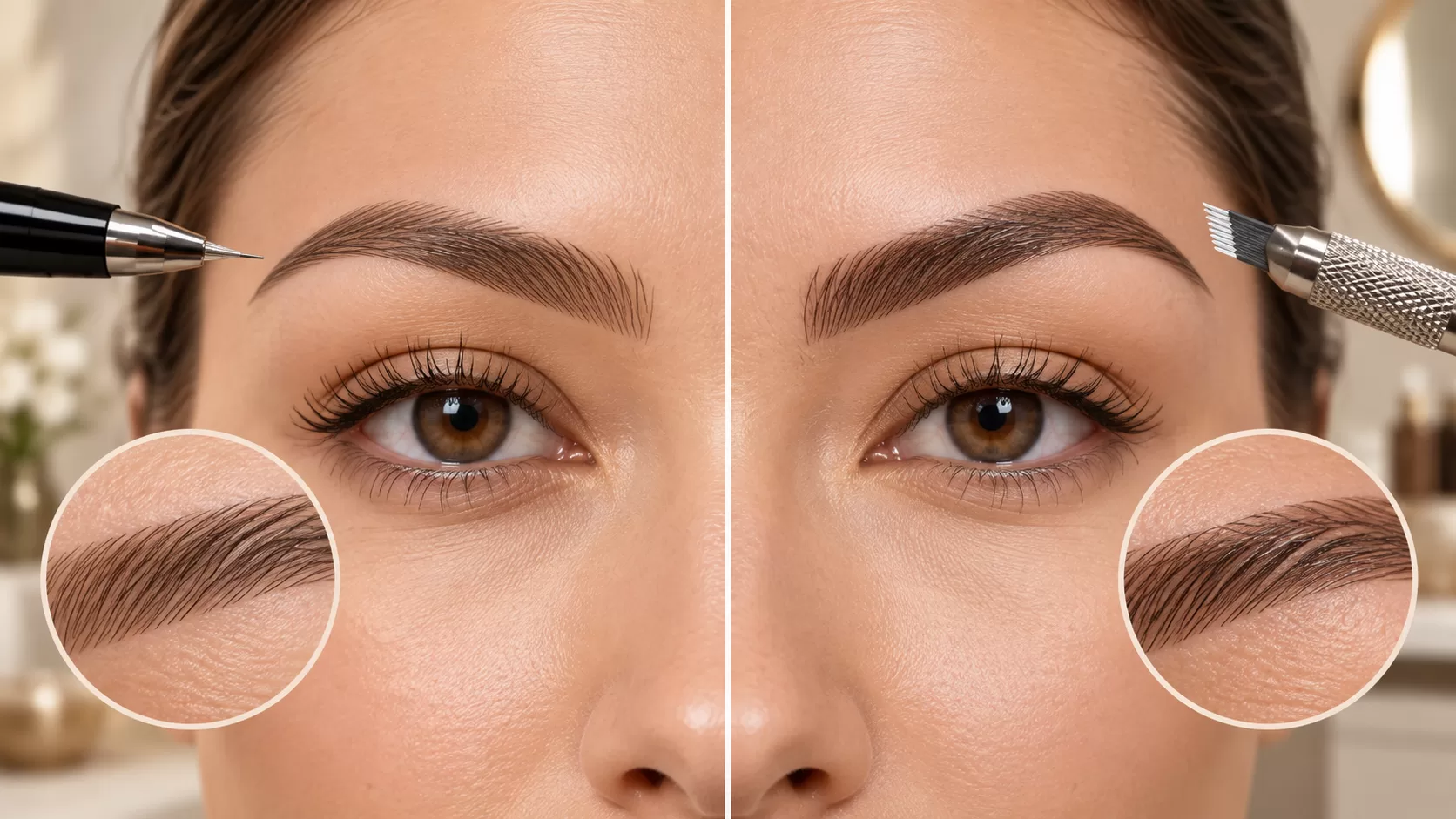
One set of brows is labeled nanoblading. Another is labeled microblading. Both seem to have fine little lines that look like real eyebrow hairs.
So naturally, you ask the question everyone asks:
What is actually the difference?
Then the harder questions arrive.
Will one blur faster on oily skin?
Is nanoblading really gentler?
Does microblading scar?
Which one looks more natural after it heals?
Which lasts longer?
And perhaps the question hiding underneath all of them:
Which one am I less likely to regret?
That is the question worth answering.
If you are researching nanoblading vs microblading in Houston, do not choose based on whichever technique sounds newer. And definitely do not choose because one Instagram post promises “three years” while another says “18 months.”
Your skin does not care about marketing terminology.
It responds to the tool, technique, pigment placement, artist control, your individual skin characteristics, healing, previous permanent makeup, and what is actually being asked of the tissue.
So let’s compare these procedures the way a client should compare them: by how they are performed, how they may heal, which skin types deserve extra consideration, what maintenance looks like, and what result you actually want to see in the mirror.
Quick answer: What is the difference between nanoblading and microblading?
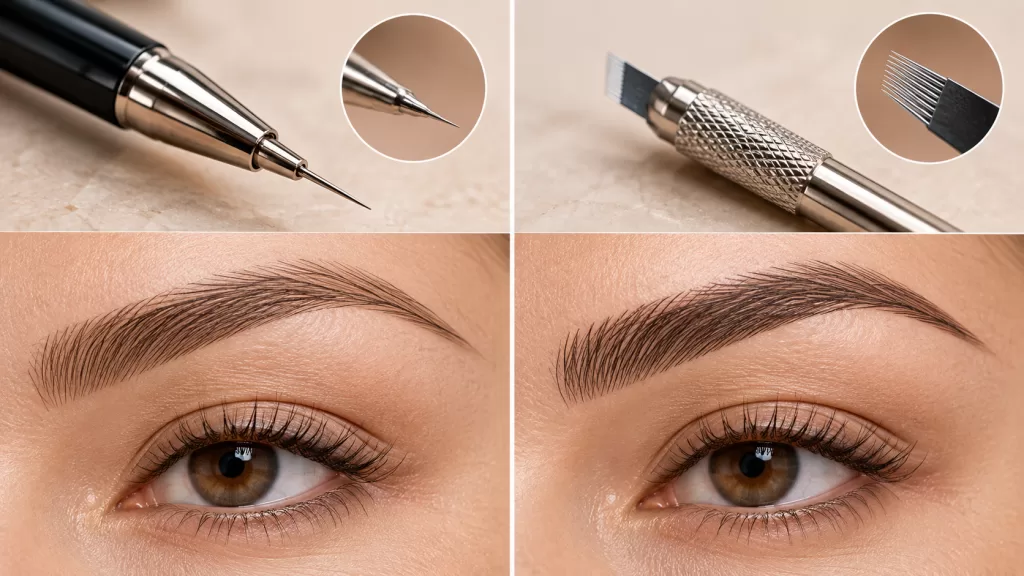
Microblading typically uses a manual hand tool fitted with a blade configuration made from very fine needles. The artist creates small linear openings in the skin and deposits pigment to imitate eyebrow hairs. Published dermatology literature describes microblading as a form of superficial micropigmentation performed with a manual device and blade.
Nano hair stroke brows, as the term is commonly used in modern permanent makeup, are usually created with a powered PMU machine and a very fine needle cartridge. Instead of manually creating blade-shaped incisions, the artist builds hair-like strokes using controlled needle movement.
At The Nano Blading in Houston, the Nano Hair Stroke Brows service uses a machine-based fine-needle approach designed to create individual hair-like details.
The important part:
Neither technique is automatically better for everybody.
Your best option depends on:
- Skin texture and oil production
- Natural brow density
- Previous microblading or permanent makeup
- Desired level of definition
- Your preferred healed look
- Artist skill and technique
- Lifestyle and maintenance expectations
That is why “nano is better” and “microblading is better” are both lazy answers.
Nanoblading vs microblading at a glance
| Factor | Nano Hair Stroke Brows | Traditional Microblading |
|---|---|---|
| Main tool | Powered PMU machine with fine needle cartridge | Manual hand tool with blade configuration |
| How strokes are created | Repeated controlled needle movements form hair-like lines | Blade-shaped manual movements create linear openings |
| Main visual goal | Fine, flexible hair-stroke pattern | Crisp hair-like stroke pattern |
| Fresh appearance | Can look extremely fine and detailed | Can also look crisp and detailed |
| Healed appearance | Depends heavily on skin, pigment, spacing and artist control | Depends heavily on skin, pigment, depth and artist control |
| Oily skin | Individual assessment needed, sometimes shading or combo may be considered | Fine strokes may retain less predictably on highly sebaceous skin |
| Mature or thin skin | Often requires conservative technique and spacing | Requires particular care with pressure and depth |
| Touch-up | May be recommended after healing | Frequently requires a perfecting session |
| Longevity | Highly variable, no universal guaranteed timeline | Published literature commonly describes about 12 to 18 months, but individuals vary |
| Previous PMU | Existing pigment may limit visible strokes | Existing pigment may also limit visible strokes |
| “Best” candidate | Determined by skin and desired result | Determined by skin and desired result |
The table is useful.
But skin is where this comparison gets interesting.
What exactly are nano hair stroke brows?
Nano hair stroke brows are a form of permanent makeup designed to imitate individual eyebrow hairs.
Rather than filling the entire eyebrow with one continuous layer of pigment, the artist creates thin lines that follow a planned growth pattern.
A good pattern should not look like twenty identical lines marching across your forehead.
Real brows contain variation.
Some hairs grow upward.
Some angle outward.
The density changes from the front to the tail.
There is visible skin between hairs.
That negative space is part of what makes natural nano brows believable.
The Nano Blading’s Houston service describes its Nano Hair Stroke Brows as using small needles to build natural-looking hair detail rather than a solid filled effect.
Nano hair strokes may appeal to you if:
- You want the least makeup-like brow possible
- Your natural brows have small gaps
- Your tails have become sparse
- You want to preserve visible skin between brow hairs
- You do not normally wear bold brow makeup
- You want individual hair detail rather than a powder effect
But wanting nano hair strokes and being an ideal candidate for them are not necessarily the same thing.
That distinction matters.
What exactly is microblading?
Microblading also aims to imitate eyebrow hairs.
The key difference is the tool and how the stroke is made.
Published dermatology research describes microblading as superficial micropigmentation using a manual device with a blade composed of stacked needles. That blade creates small hair-like incisions into which pigment is deposited.
That can create very convincing eyebrows when performed well.
Microblading became enormously popular precisely because it offered something older eyebrow tattooing often did not: visible individual strokes rather than one solid block of color.
Microblading may appeal to clients who:
- Want recognizable hair-like strokes
- Have suitable skin for manual stroke work
- Have sparse or uneven brows
- Prefer a traditional manual method
- Have access to a highly experienced microblading artist with excellent healed work
And that last sentence is more important than it looks.
A great microblading artist is preferable to an inexperienced nano artist simply because “nano” sounds newer.
The tool does not compensate for bad judgment.
The biggest difference is not the name. It is how the stroke enters the skin.
Marketing often simplifies this into:
Microblading cuts. Nano does not.
That is not a sufficiently useful explanation.
Both procedures place pigment into skin.
Permanent makeup is a form of tattooing, and the FDA specifically includes permanent eyebrow makeup and microblading inks within tattoo and permanent-makeup safety information.
The practical difference is that traditional microblading forms strokes using manual blade movements, while machine-based nano hair strokes are built through repeated needle movements.
That distinction can influence:
- How the artist controls the line
- How much pressure is applied
- Stroke flexibility
- Spacing
- How a technique behaves on different skin textures
But do not turn that into another absolute claim.
A poorly controlled machine needle can still create a bad result.
A highly skilled manual artist can create excellent microblading.
Technique matters. Depth matters. Pressure matters. Skin matters.
Is nanoblading really less traumatic than microblading?
This is where I would deliberately be more careful than most beauty blogs.
Machine nano techniques do not create strokes in exactly the same way as a manual microblade. That is one reason many permanent makeup artists prefer machine hairstrokes for certain clients.
But saying:
“Nanoblading causes less skin trauma for everyone”
goes beyond what strong comparative evidence currently proves.
The amount of tissue disruption also depends on:
- Artist pressure
- Needle configuration
- Depth
- Number of passes
- Skin thickness
- Existing scar tissue
- Previous permanent makeup
So the more useful question is not:
Which technique is theoretically less invasive?
Ask:
Which technique can this particular artist execute most predictably on my skin?
That is the information you actually need.
Which looks more natural: nanoblading or microblading?
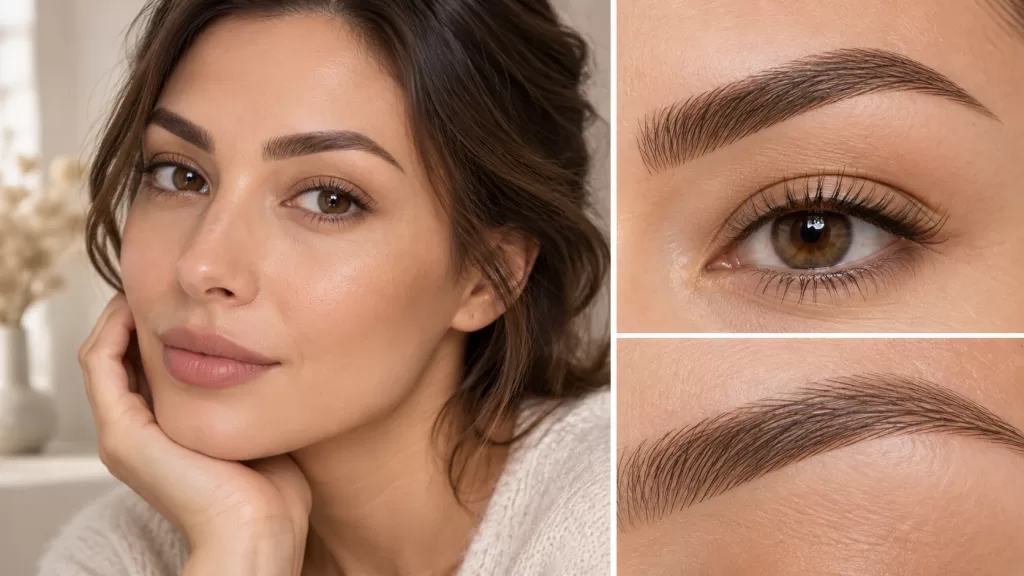
Both can look natural.
Both can also look unnatural.
The word natural gets abused badly in permanent makeup.
A brow does not look natural simply because it contains hair strokes.
You can create thirty extremely crisp strokes in the wrong direction, the wrong color, the wrong thickness and the wrong shape.
Technically, those are hair strokes.
Visually, they are still announcing themselves from across the room.
A natural-looking result depends on:
Stroke direction
New strokes should follow believable eyebrow growth.
Spacing
Natural brows contain negative space. Packing strokes too tightly together can eventually make them appear denser or less distinct.
Pigment color
The tattooed strokes should interact naturally with existing brow hair and skin.
Brow mapping
The shape should support your facial proportions instead of forcing every client into the artist’s favorite template.
Density
Sparse natural brows may need a different strategy than brows that are already 70 percent complete.
Nano machine work can be particularly attractive when the goal is very fine, flexible hair patterns.
Traditional microblading can also create convincing hair-like work when it is appropriately performed.
Judge portfolios by healed results, not terminology.
Nano brows vs microblading for oily skin
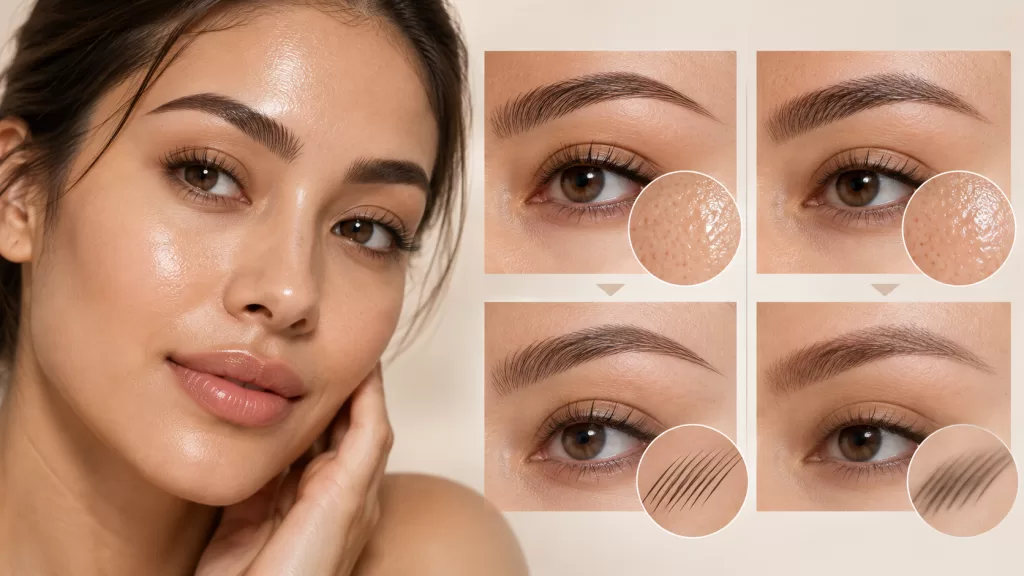
This is one of the most searched comparisons, and for good reason.
Oilier skin can make very fine hairstroke work more challenging.
A recent clinical review of microblading notes that semi-permanent pigment retention can be poor in individuals with high sebaceous gland density or activity.
That does not mean:
Oily skin can never have hair strokes.
It means the decision deserves more thought.
If your brow and forehead area becomes visibly oily throughout the day, the artist should consider:
- Pore appearance
- Oil production
- Natural hair density
- Stroke spacing
- Desired definition
- Whether shading would provide more reliable structure
For some clients, the better discussion may be:
nano hair strokes vs combo brows
or:
nano hair strokes vs soft shading
rather than nano vs microblading.
Your existing guide on choosing between Nano Hair Strokes, Combo Brows, and Shading goes deeper into that decision.
If you have very oily skin
I would not walk into the consultation demanding one particular technique.
Ask instead:
“If individual hair strokes heal softer on my skin, what technique would give me the most natural-looking healed result?”
That question gives your artist room to solve the actual problem.
Nano brows vs microblading for normal or dry skin
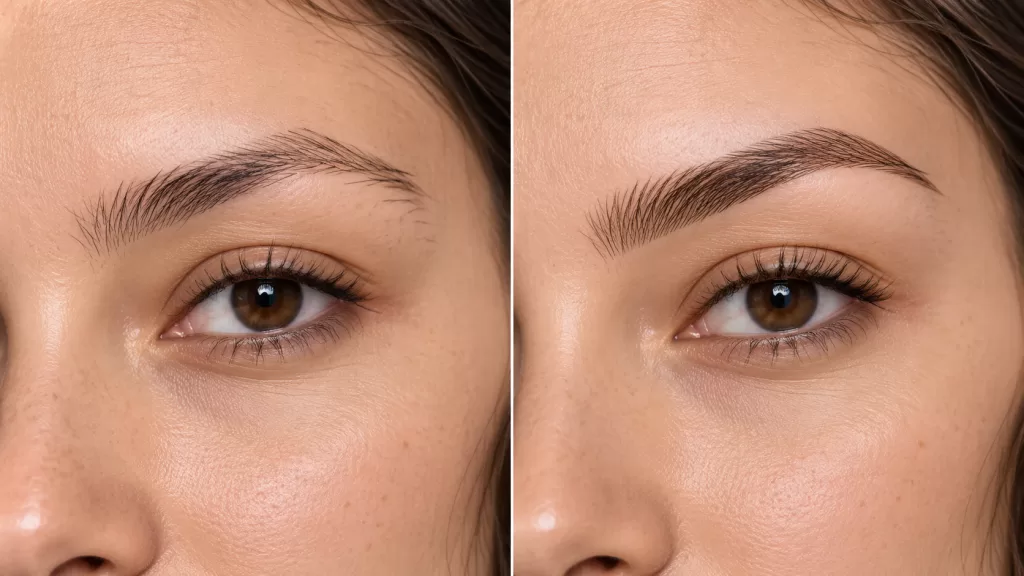
Normal and drier skin can often support detailed hairstroke work well, assuming the skin is otherwise suitable.
That means you may have more freedom to compare nano and microblading based on:
- Artist portfolio
- Preferred stroke style
- Desired softness
- Existing brow density
- Long-term maintenance preferences
But dry skin is not a golden ticket.
Someone with dry skin can still have:
- Previous pigment
- Scar tissue
- textured areas
- skin conditions
- very sparse hair
- expectations better suited to shading
Skin type is one part of the decision.
Not the whole decision.
Nano brows vs microblading for mature or thin skin
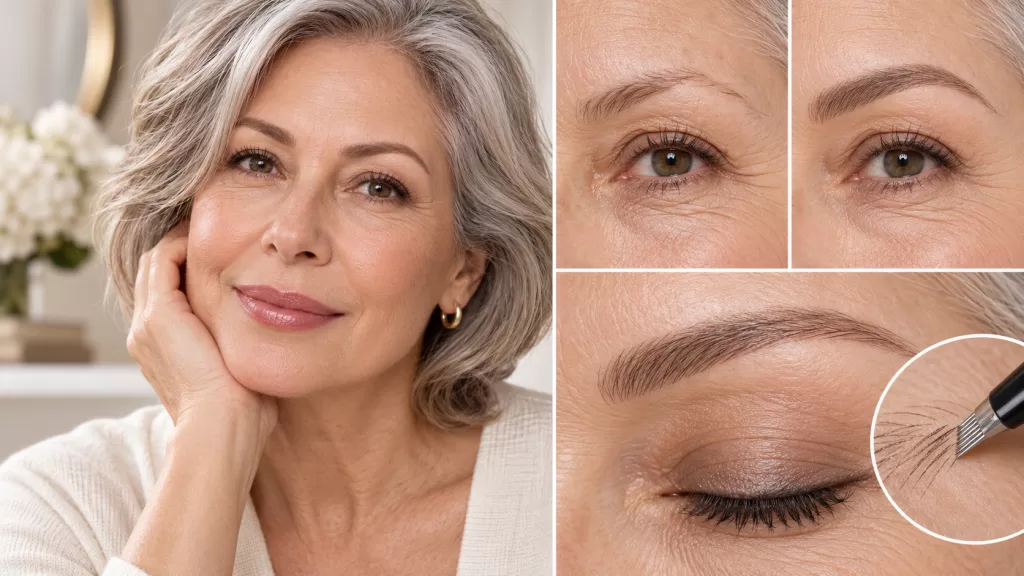
This is where “more strokes” can become a bad strategy.
Skin often changes with age, and mature clients may have areas that are drier, thinner or more textured.
That does not mean mature skin cannot have beautiful hair-stroke brows.
It means restraint becomes important.
For some mature clients, carefully spaced machine hair strokes may create an elegant, natural result.
For others, forcing dense hairstrokes into delicate or highly textured skin may produce less visual consistency than:
- Fewer strokes
- Soft shading
- A combo technique
- A deliberately lighter design
The goal is not proving that nano brows can be done.
The goal is choosing what will look flattering after healing.
That is a very different mindset.
Is nanoblading better for sensitive skin?
“Sensitive skin” can mean many different things.
It may mean someone becomes red easily.
It may mean they react to skincare.
It may mean they have an active dermatologic condition.
Those are not interchangeable.
Do not choose nano or microblading solely because one website describes it as “better for sensitive skin.”
Permanent makeup creates a controlled injury to the skin and carries possible risks including infection, allergic reaction, scarring and other adverse responses.
If you have active irritation, infection or another skin problem around the eyebrows, discuss it with the artist and an appropriate healthcare professional before proceeding.
Which procedure hurts more?
This question deserves a boring but accurate answer:
Pain is subjective.
One client’s “barely felt it” is another client’s “why did I book this?”
Permanent makeup professionals may use topical numbing according to their protocol and applicable rules.
The sensation can also differ because the techniques feel mechanically different.
But I would not promise:
Nano brows are painless.
And I would not promise:
Microblading is painless.
A professional should prepare you for possible discomfort rather than sell the service by pretending nerve endings suddenly resigned.
Does microblading cause more scarring?
Microblading uses manual blade-created strokes, so depth and pressure control matter enormously.
Poorly performed or repeatedly overworked permanent makeup can contribute to unwanted skin changes or scarring.
But machine-based permanent makeup is not magically incapable of creating problems.
The FDA lists scarring among potential tattoo and permanent makeup complications and also warns that pigment placed too deeply can migrate, producing a blurred appearance.
The risk-management strategy is therefore not:
Choose nano and forget about it.
It is:
- Choose an experienced artist
- Look at healed work
- Verify studio hygiene
- Avoid unnecessary oversaturation
- Follow aftercare
- Do not repeatedly tattoo the same area simply because the calendar says “touch-up”
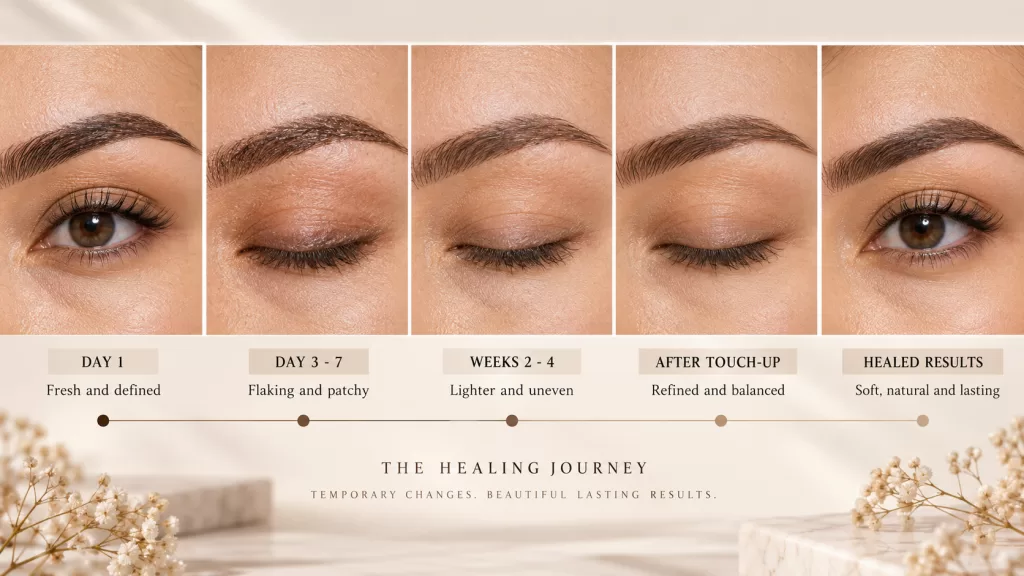
Nanoblading vs microblading healing
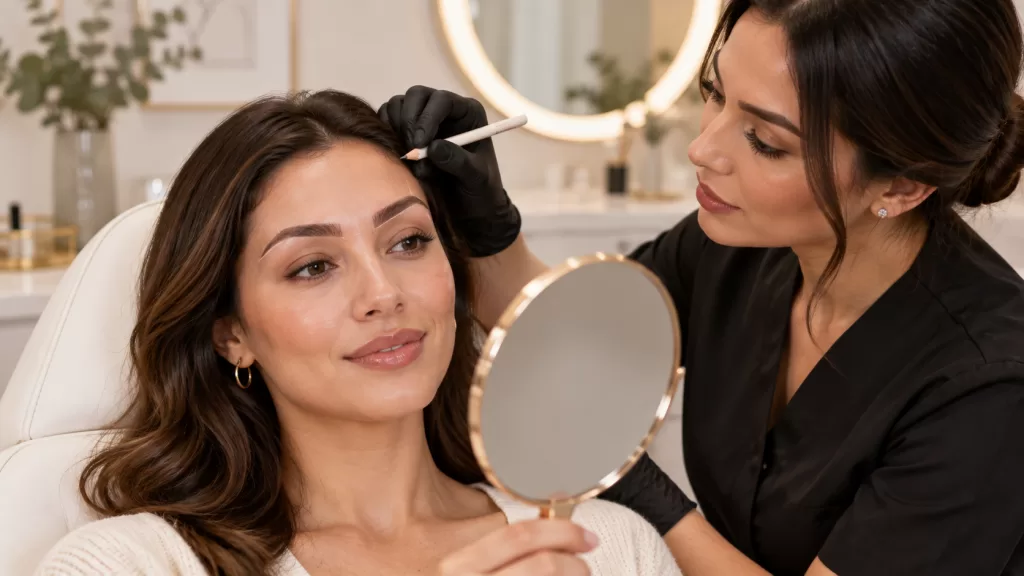
Both procedures need healing time.
Your brows will not look identical from appointment day through the final healed result.
Common early changes can include:
- More intense pigment
- Mild redness or tenderness
- Dryness
- Flaking
- Temporary unevenness
- Lighter-looking pigment during healing
- Small areas that retain differently
Your final brow should not be judged on day one.
Or day four.
Or while half the brow is flaking and the other half is making its own plans.
The updated What to Expect After Nanoblading guide explains the healing stages in greater detail.
Your Nanoblading Aftercare guide covers washing, exercise, makeup, Houston heat, sun exposure, and the things you should not do while the skin is recovering.
Do both nanoblading and microblading need touch-ups?
Machine nano hair strokes can also heal with areas that need refinement.
A perfecting appointment may be used to:
- Reinforce lighter strokes
- Adjust density
- Balance the two brows
- Fine-tune color
- Add subtle shading when appropriate
But a touch-up should not mean tattooing everything again automatically.
If part of the brow healed beautifully, leave it alone.
More pigment is not always better pigment.
Which lasts longer: nanoblading or microblading?
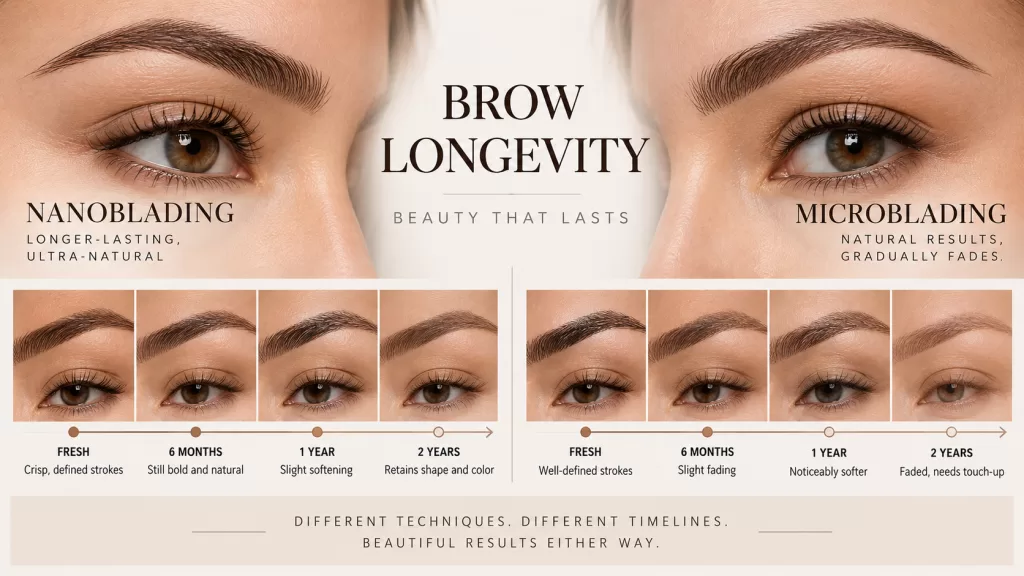
For machine nano hairstrokes, marketing longevity ranges vary considerably, but strong head-to-head clinical evidence showing one universal lifespan versus microblading is limited.
Actual visible retention depends on:
- Skin type
- Oil production
- Pigment
- Technique
- Depth
- Sun exposure
- Skincare
- Lifestyle
- Healing
- How soft you personally consider “faded”
Someone who loves barely-there brows may wait longer before refreshing them.
Someone who wants strong definition may return much sooner even though pigment remains visible.
So do not choose between nanoblading and microblading because somebody advertised the biggest number of years.
Choose based on how you want the brow to age.
What happens if you already have old microblading?
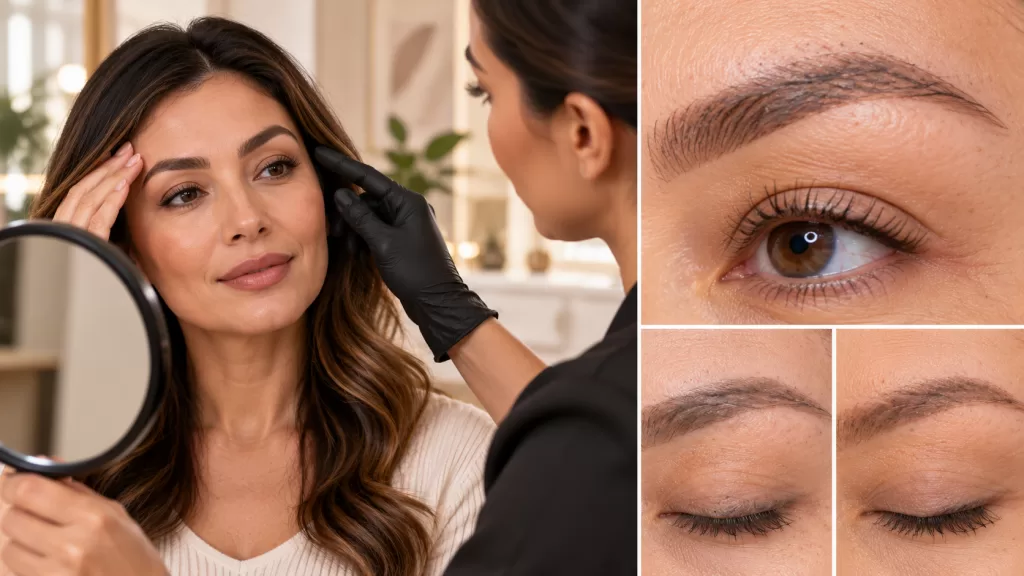
This can completely change the decision.
If you have previous:
- Microblading
- Powder brows
- Ombre brows
- Nano brows
- Cosmetic eyebrow tattooing
the artist needs to evaluate what remains before adding anything.
Hair strokes need visible space.
If your old eyebrow is already heavily saturated, adding delicate nano lines on top may be like drawing individual hairs onto brown construction paper.
Technically, the lines are there.
Nobody can see them.
Your options may include:
- Waiting for more fading
- Color correction
- Soft shading
- Removal
- Selective new work
- No additional pigment yet
A qualified artist should be willing to tell you when neither nano nor microblading is the right next move.
That “no” can save you a lot of money later.
Can you switch from microblading to nano brows?
Sometimes.
But it depends on what your old microblading looks like.
If the previous strokes have faded significantly and there is enough clear skin to create visible new hair patterns, machine nano strokes may be possible.
If the old pigment is:
- Very dark
- Gray
- Red
- Highly saturated
- Outside the desired new shape
the artist may recommend correction, fading, removal or another technique first.
Do not assume nano brows can simply cover old microblading.
Permanent makeup is not wall paint.
Which is better if you have almost no natural brow hair?
Pure hair strokes can look beautiful without much natural hair, but the design becomes more technically demanding because the tattoo itself must carry almost the entire illusion.
If you have very little brow hair, your artist may discuss:
- Nano hair strokes
- Combo brows
- Soft shading
- A combination of techniques
A few ultra-fine strokes scattered across a completely hairless brow may not create enough visual structure for someone who wants fuller definition.
Again, this is why the desired healed result matters more than the procedure name.
Which is better if you want the most natural result?
If your definition of natural is:
“I want people to think these are my own hairs.”
machine nano hair strokes deserve strong consideration.
The Nano Blading’s Houston Nano Hair Stroke Brow service is specifically designed around natural-looking individual hair detail.
But if your skin is not ideal for maintaining visible individual strokes, a light combo or shading technique can sometimes look more natural after healing than forcing hairstrokes that blur together.
Natural is the result.
Not the tool.
Which is better if you normally fill in your eyebrows?
If you usually use pencil, powder or pomade across most of your brow, pure hair strokes may feel too subtle.
You may prefer:
Combo brows, where hair strokes provide realism and shading provides density.
Or:
Nano Ombré Shading Brows, which create a softer filled appearance with a gradient rather than relying entirely on strokes.
This is one reason I would not reduce your decision to nano vs microblading.
Sometimes the correct answer is:
Neither.
Decision guide: Which technique should you discuss first?
| Your situation | Technique worth discussing |
|---|---|
| “I want extremely natural hair-like detail” | Nano hair strokes or well-executed microblading |
| “I have normal to dry skin” | Either may be considered |
| “My skin is very oily” | Nano, combo or shading may deserve stronger consideration |
| “My skin is mature or thin” | Conservative nano strokes, combo or soft shading |
| “I have almost no brow hair” | Nano, combo or shading depending on desired density |
| “I fill in my whole brow daily” | Combo or shading may better match your style |
| “I already have old microblading” | Assessment before either technique |
| “I want the longest possible result” | Do not choose by longevity marketing alone |
| “I am afraid of brows looking tattooed” | Prioritize healed portfolios and soft design |
| “I want bold, polished brows” | Shading or combo may suit you better |
Use that table to start the consultation.
Do not use it to diagnose your eyebrows from the couch.
Houston clients should think about healing, not just technique
Whether you choose nano brows in Houston or microblading, the city gives you one practical issue:
Sweat.
Houston heat and humidity can make an ordinary afternoon feel suspiciously similar to cardio.
During early healing, your artist may ask you to modify activities involving:
- Heavy sweating
- Pools
- Steam
- Saunas
- Prolonged direct sun
- Intense outdoor exercise
That does not mean Houston makes one brow technique inherently better.
It means appointment timing matters.
Do not book permanent makeup two days before:
- A beach weekend
- Outdoor festival
- Hot yoga retreat
- Pool vacation
- Major athletic event
You are paying for permanent makeup.
Give the skin a few quiet days instead of immediately putting it through the Houston Olympics.
Safety matters more than nano versus micro
Both procedures involve placing pigment into skin.
That means the artist and studio matter enormously.
The FDA lists potential permanent makeup risks including infection, allergic reactions, scarring, granulomas, and removal difficulties.
In Texas, businesses performing permanent cosmetics and microblading fall under tattoo studio licensing requirements. Texas DSHS requires qualifying businesses to hold a current license and includes sanitation and infection-control requirements.
Before choosing either procedure, ask:
- Is the studio properly licensed?
- Can I see healed results?
- Are needle cartridges or relevant components single-use?
- How is cross-contamination prevented?
- Which pigment is being used?
- What technique do you recommend for my skin?
- What would make you refuse to perform this technique on me?
That final question is excellent.
A professional who has reasons to say no is often more trustworthy than someone who says every client is perfect for whatever service they happen to sell.
Frequently asked questions
Is nanoblading better than microblading?
Not universally. Nano hair strokes usually use a powered PMU machine, while microblading uses a manual blade configuration. The better option depends on your skin, natural brow hair, previous pigment, desired healed result, and the artist’s expertise.
Do nano brows look more natural than microblading?
Nano machine hairstrokes can create very fine hair-like detail, but both techniques can look natural when performed well. Shape, stroke direction, spacing, color, and healed pigment matter more than the procedure name alone.
Does nanoblading last longer than microblading?
There is no reliable universal rule proving that nano brows always last longer. Published literature commonly describes traditional microblading at approximately 12 to 18 months, while machine nano retention varies based on skin, technique, pigment, lifestyle, and maintenance.
Is nanoblading better for oily skin?
It may be considered for some oily-skin clients, but there is no guarantee. Research has noted poorer microblading pigment retention in highly sebaceous skin. Some clients may achieve a more consistent result with machine work, combo brows, or shading depending on the skin.
Is nanoblading good for mature skin?
It can be. Mature skin should be individually evaluated because texture and thickness vary significantly. Carefully spaced nano strokes may work beautifully for some clients, while soft shading or a combination technique may be more flattering for others.
Is nanoblading less painful than microblading?
Not necessarily for everyone. Pain tolerance varies, and both procedures may involve topical numbing according to the artist’s protocol. No reputable artist should promise a completely painless procedure.
Can microblading cause scars?
Any procedure that disrupts the skin can potentially contribute to unwanted skin changes if performed improperly. The FDA lists scarring among possible tattoo and permanent makeup complications. Proper depth, hygiene, and artist skill matter.
Do nano brows need a touch-up?
They may. Pigment can heal lighter or unevenly in some areas, and a perfecting session may be recommended after sufficient healing.
Can I get nano brows over old microblading?
Sometimes, but the existing pigment must be evaluated first. If old microblading remains highly saturated, discolored, or outside the desired shape, correction, additional fading, or removal may be recommended before new hairstrokes.
Which brow technique should I choose?
Choose based on your desired healed result, skin, natural brow density, and existing pigment rather than the trendiest technique name. A consultation should determine whether nano hair strokes, microblading, combo brows, or shading makes the most sense for you.
The winner is not nanoblading or microblading. It is the technique that still looks right after healing.
That is where I would end the battle.
Because choosing brows is not like choosing between two phones where one has a faster processor.
Your skin is part of the system.
Your natural brow hairs are part of the system.
Your artist is a very large part of the system.
The technique that produces beautiful results on your friend’s dry skin may not be the smartest option for your oily skin.
The microblading artist with ten years of excellent healed work may be a better choice than someone who started offering “nano brows” last month because the term gets clicks.
And sometimes the best solution is not either technique.
It may be combo brows.
Soft shading.
Correction.
More fading.
Or simply leaving existing pigment alone for a while.
If you are considering nano brows in Houston, start with the result you want rather than the procedure name.
Tell your artist:
“I want these to look like real hairs.”
Or:
“I want a soft filled look.”
Or:
“I want to stop drawing my tails every morning without looking like I have tattooed eyebrows.”
That is useful information.
Then let your skin, existing brows, and healed-result goals guide the technique.
At The Nano Blading in Houston, you can explore Nano Hair Stroke Brows for fine hair-like detail and Nano Ombré Shading Brows for a softer filled effect before deciding which approach makes the most sense for your brows.
Book a consultation to compare your skin, natural brow hair, previous pigment, and preferred healed look before choosing the technique.
